The Performance Trap
Perfectionism can quietly drain clarity, trust, and momentum. Learn how the performance trap keeps leaders stuck in self-judgment and how aligned leadership begins with internal ownership.
When Perfection Becomes the Thing That Slows You Down
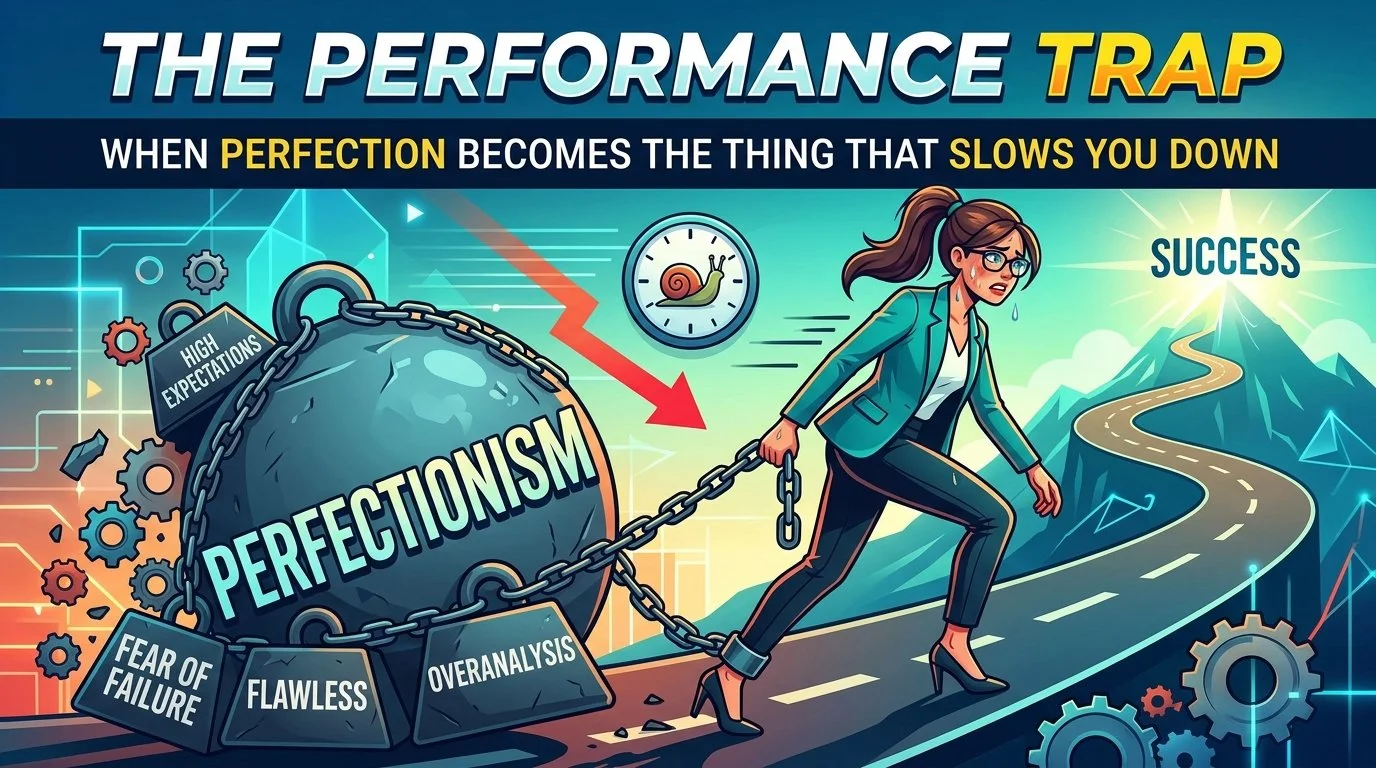
There is a kind of leadership pressure that can look admirable from the outside. It looks like discipline. It looks like drive. It looks like high standards, sharp instincts, and a refusal to settle. Yet underneath it, there can be something far less noble and far more exhausting: a quiet dependence on pressure, a private fear of imperfection, an inner agreement that says your authority must be earned again and again through flawless execution. This is the performance trap. It is what happens when excellence stops being an expression of care and becomes a mechanism of self-protection. It is what happens when your drive is no longer rooted in purpose, but in the need to outrun your own self-criticism. While it may still produce motion, it does not produce peace. It does not produce spaciousness. It does not produce the kind of leadership that can breathe.
The lie beneath the striving
Many leaders have been taught to call this excellence. They have been taught that relentless perfection is the cost of entry. That constant self-pressure is proof of responsibility. That an unforgiving inner standard is what keeps them sharp, relevant, and worthy of the room they are in. However, often this is not excellence at all. It is fear in a tailored suit. It is self-doubt dressed up as professionalism. It is internal judgment wearing the language of ambition. It is a life built around avoiding the sting of your own disapproval. This is the executive lie: the belief that perfectionism is strategic, when in truth it is often defensive. The leader believes they are building authority, when in reality they are exhausting themselves trying to keep authority from collapsing.
When the inner world becomes a courtroom
One of the clearest signs of the performance trap is that your inner world no longer feels like a place of guidance. It feels like a place of trial. The mind becomes a courtroom. The inner critic becomes the loudest voice in the room, and every unfinished task, delayed decision, imperfect conversation, or missed detail becomes evidence. You may still look capable. You may still be achieving. You may still be admired. However, internally, your energy is being drained by a cycle of self-accusation.
This is the hidden friction so many leaders live with: not a lack of ability, but a constant internal drag. A grinding mental static. A tension that narrows perspective. A subtle emotional tax that makes even important work feel heavier than it should and because the mind is so busy managing self-judgment, it has less room for what leadership actually requires: discernment, creativity, courage, clarity, relationship, and the spaciousness to think beyond survival.
The alignment barrier
This is where the alignment barrier begins. An alignment barrier is the friction created when your outer efforts are no longer in harmony with your inner values. It is the distance between the leader you long to be and the internal patterns interrupting your ability to embody that leader fully. When this barrier is present, your leadership begins to leak energy. Not always visibly. Sometimes very quietly.
You work harder, but trust feels thinner.
You stay busy, but momentum feels stalled.
You remain productive, but deeply tired.
You keep holding more, but feel less steady.
This is because a mind burdened by self-defense cannot fully offer itself to aligned execution. Too much energy is being spent managing internal threat.
The mirror effect
What remains unresolved within a leader rarely stays contained there. This is one of the deepest truths of self-leadership: the atmosphere you live in internally will eventually shape the atmosphere you create externally. If you are harsh with yourself, that harshness often echoes outward. If your inner world is built on suspicion, pressure, and impossible standards, your leadership presence will often carry that same tone, even when your words sound measured. This is the mirror effect. We project onto others what we have not yet made peace with inside ourselves. A lack of compassion inward often becomes condemnation outward. A leader begins assuming the worst, not because others are always failing, but because their own inner architecture has taught them to interpret imperfection as danger. When that happens, trust begins to erode. The room becomes more careful. People brace instead of contribute. Feedback feels heavy. Collaboration becomes defensive. Culture tightens. The leader may think the issue is performance, but often the deeper issue is resonance.
Fear-driven performance versus purpose-driven commitment
There is a difference between action fueled by fear and action rooted in purpose. Fear-driven performance is exhausting because it is constantly trying to prove safety, worth, and competence. It burns energy quickly because the leader is not only doing the work, but defending against the possibility of being found lacking. Purpose-driven commitment feels different. It is still devoted. Still disciplined. Still clear, but it is no longer frantic. It is not trying to earn the right to exist. It is not building identity out of outcomes. It is not confusing control with strength. Purpose-driven leadership draws from something steadier: clarity, values, trust, resilience, service, conscious choice. This is where sustainable authority begins. Not in the constant maintenance of image, but in the quiet congruence of a leader whose inner and outer life are no longer at war.
The three shifts back to yourself
The way out of the performance trap is not more force. It is not another layer of pressure. It is not becoming harder on yourself in the hope that one day you will finally feel secure. The way out is a return. A return to self-leadership. A return to internal ownership. A return to authority that is not built on self-accusation. This return happens through three shifts.
1. The Responsibility Reclaim
This is the shift from being run by judgment to becoming the owner of thought. It begins when you notice the accusations in your mind and stop treating them as unquestioned truth. It begins when you recognize how much of your energy has been lost to self-justification, inner defensiveness, and the exhausting work of arguing with yourself. Ownership does not mean pretending everything is fine. It means telling the truth without turning the truth into a weapon. It means replacing: “I am failing” with “I need a clearer structure.” It means moving from emotional sting to practical clarity, and that shift is not small. It is foundational.
2. The Compassion-First Protocol
Compassion is not softness without standards. It is intelligent leadership of the inner world. When self-condemnation begins to loosen, something opens. There is more space for honesty. More room for repair. More capacity to see others clearly instead of reactively. A leader who has learned to extend inward compassion is more able to offer outward steadiness. They become less ruled by projection, less quick to assume incompetence, less likely to use pressure as their primary mode of influence. This is where trust culture begins: not in slogans, but in the emotional maturity of the leader.
3. Purpose Over Performance
Eventually, leadership must become anchored in something deeper than perfect results. When a leader is still addicted to perfection, their authority remains fragile. It rises and falls with outcomes. It needs external proof to feel stable. It hoards tasks, over-controls details, and struggles to release responsibility because imperfection feels personally threatening. However, purpose-rooted leadership is different. It is anchored in values. It can delegate without panic. It can move without needing certainty. It can remain steady even when the week is imperfect. This is the beginning of aligned execution: action without the drag of self-doubt, leadership without the constant ache of proving, authority that comes from congruence rather than applause.
Why small practices matter
Transformation is not always dramatic. Sometimes it begins with ten honest minutes. A small interruption. A replaced sentence. A single moment where you choose clarity instead of condemnation. A quiet act of self-leadership that breaks the old loop and reminds your mind that it no longer has to live in accusation. This is why the small practices matter. Not because they are simplistic, but because repetition rewires. A thought named becomes less powerful. A judgment interrupted loses some of its grip. A delegated task reveals the fear beneath the control. A chosen value begins to build a new inner architecture. The smallest moments of ownership can create the greatest openings.
The real question beneath it all
At some point, every leader must ask: What is this costing me?
Not only in output. Not only in time. But in peace. In trust. In energy. In creativity. In the culture forming around me. In the kind of leader I could become if I were no longer spending so much strength defending myself from myself. Because there is a cost to the performance trap. A cost to calling self-pressure strength. A cost to mistaking perfection for safety. A cost to remaining outwardly accomplished while inwardly crowded.
There is another way—to lead from clarity. To reclaim your inner authority. To move from fear-driven performance into purpose-driven presence. To become the kind of leader whose power is no longer fueled by pressure, but by alignment. That is the deeper invitation. It is not about more proving or using more force. Rather, it is a quiet return.
If this stirred something in you, pause there. You may not need more discipline. You may need relief from the inner system that keeps turning leadership into self-defense. The work of alignment begins by telling the truth about what pressure has been costing you. From there, a different kind of authority becomes possible.
The Lamp of Alignment
Burnout is rarely a productivity problem. More often, it is a signal that something deeper has fallen out of alignment. Modern organizations are frequently designed around pressure, urgency, and measurable output. While these forces can produce short bursts of performance, they are not sustainable foundations for human vitality or meaningful work. Over time, teams that operate under constant pressure begin to experience depletion, fragmentation, and disengagement.
A Leader’s Guide to Sustainable Presence and Coherent Culture
Introduction
From Burnout to Alignment
Burnout is rarely a productivity problem. More often, it is a signal that something deeper has fallen out of alignment. Modern organizations are frequently designed around pressure, urgency, and measurable output. While these forces can produce short bursts of performance, they are not sustainable foundations for human vitality or meaningful work. Over time, teams that operate under constant pressure begin to experience depletion, fragmentation, and disengagement.
Insight4Alignment approaches leadership from a different premise. Human beings do not thrive under endless performance pressure. They thrive when the internal architecture of identity, dignity, trust, and presence is coherent. When that internal structure is aligned, individuals bring clarity, creativity, and resilience to their work. Teams become not only capable of producing results, but also capable of sustaining meaningful contribution over time.
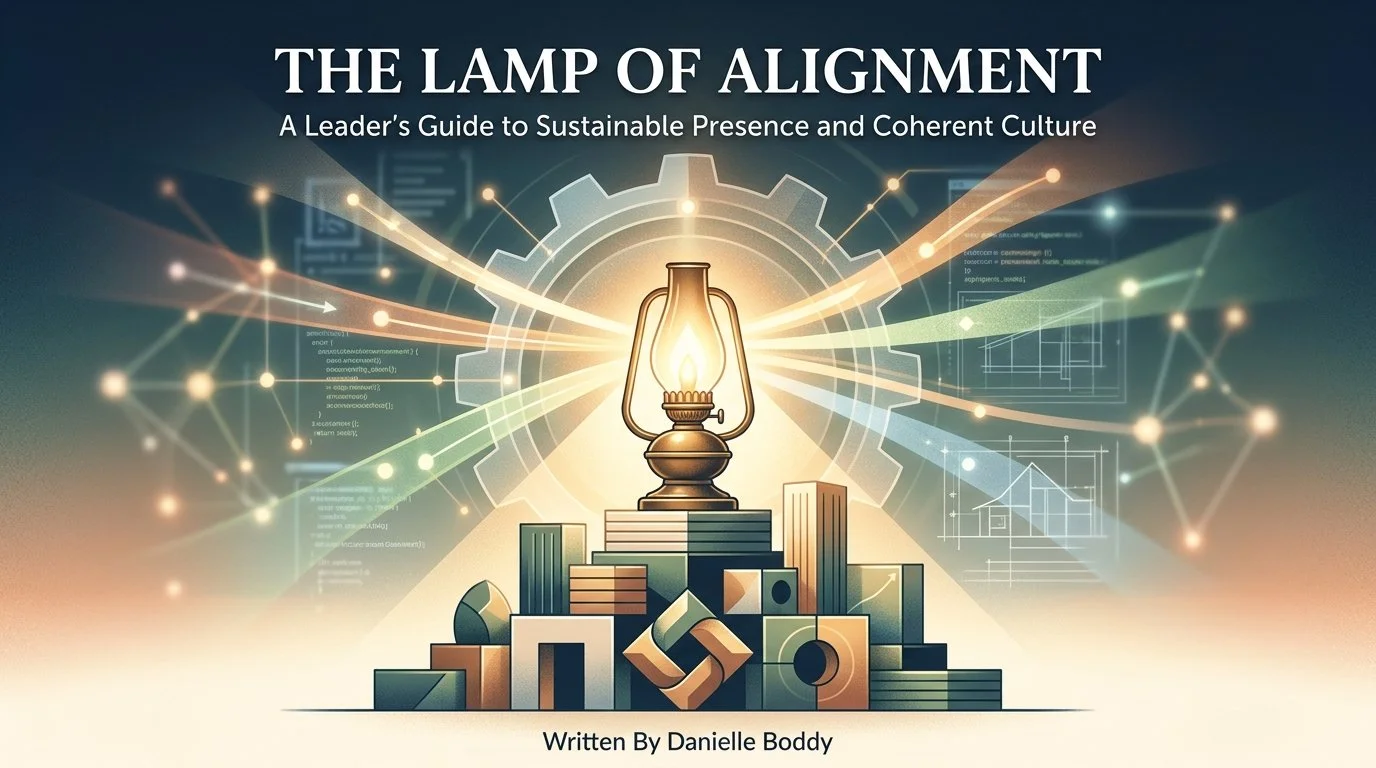
At the heart of this approach is a guiding metaphor: The Lamp of Alignment. This lamp represents the living vitality of a team.
Within this metaphor:
The Flame represents the team’s energy, focus, and creative capacity.
The Oil represents shared wisdom, values, and relational trust.
The Wick represents the structures and systems that channel energy into meaningful work.
A healthy organization learns how to tend this lamp so that the flame can burn brightly without burning out. The first step in doing so is recognizing that burnout is not simply exhaustion. It is often a symptom of misalignment.
1. The Core Principle
Alignment Creates Coherence
Burnout frequently emerges when there is a gap between what people believe matters and what their work actually requires them to do. When values and actions diverge, people experience internal friction. Over time, this frictionbecomes fatigue.
Alignment restores coherence. In an aligned organization, the inner world of the team — its values, awareness, and sense of purpose moves in harmony with the outer world of projects, decisions, and results. This coherence can be understood through two dimensions.
The Inner World
Values
Awareness
Energy
Trust
The Outer World
Actions
Communication
Projects
Results
When these dimensions move together, the organization becomes coherent rather than reactive. A reactive team is constantly pulled in different directions by external demands. An aligned team moves with intention.
This shift from reaction to intention is not a soft concept. It produces tangible benefits:
• stronger decision-making
• lower turnover
• increased creativity
• greater resilience during uncertainty
Alignment creates a culture where people can contribute fully without sacrificing their well-being.
2. Pillar One
Cultivating the Inner Oil: Resilience Through Culture
A team’s resilience functions like oil within the lamp. It is the reservoir that allows energy to continue flowing even during seasons of difficulty. This oil is not created through occasional retreats or motivational speeches. It is built through daily practices that reinforce trust, reflection, and integrity.
Three practices are essential.
Reflection
Healthy teams create space to learn. Regular debriefs, thoughtful dialogue, and honest evaluation help prevent unresolved tensions from accumulating beneath the surface. Reflection keeps the team’s inner environment clear.
Compassion
Psychological safety allows people to show up as whole human beings rather than guarded performers. When individuals can acknowledge mistakes, ask for help, and support one another without fear of blame, the relational fabric of the team strengthens. Compassion is not weakness. It is the soil where trust grows.
Integrity
Integrity aligns words with actions. When leaders communicate transparently and make decisions consistent with the values they express, clarity replaces confusion. Integrity removes the ambiguity that often drains energy from teams.
Each act of courage, honesty, or responsibility quietly replenishes the oil of the organization.
3. Pillar Two
Tending the Flame: Rhythms of Sustainable Energy
A flame cannot be ignored until it flickers. It must be tended continuously. Sustainable performance grows from simple rhythms that protect the energy and focus of the team. Three practices are particularly powerful.
Presence
The most creative work happens in moments of genuine attention. Encouraging presence means protecting focused time, minimizing unnecessary interruptions, and cultivating awareness in meetings and collaboration. A present team produces better work with less strain.
Clarity
Confusion wastes energy. Leaders serve their teams by continually clarifying priorities, removing unnecessary complexity, and ensuring that each person understands how their work contributes to the whole. Clarity removes friction from the system.
Gratitude
Recognition restores meaning. When leaders acknowledge effort, creativity, and dedication with sincerity, they reinforce the shared purpose of the work. Gratitude reconnects people to why their contribution matters.
Together, these rhythms create an environment where energy circulates rather than drains.
4. Pillar Three
Turning Reflection into Action
Values only become real when they shape behavior. An aligned culture emerges when reflection and action reinforce one another. This requires leaders who consistently embody what they teach. Values must appear not only in mission statements, but in daily decisions. In hiring. In how mistakes are handled. In how success is defined.
When values are lived visibly, trust deepens and the culture begins to sustain itself. Each act of integrity, compassion, and courage strengthens the system. The lamp continues to burn.
5. The Role of the Leader
Becoming the Lamp
Leadership within an aligned culture is less about authority and more about coherence. A leader becomes luminous when their identity, words, and actions move in harmony. At that point, influence shifts. Instead of forcing energy into the system, the leader becomes a steady source of clarity and trust. In such environments, people begin to rediscover their own sense of purpose. They remember why their work matters. They feel safe enough to bring their full intelligence and creativity to the table. This is how leaders ignite others. Not by demanding performance, but by modeling alignment.
Conclusion
Cultivating Light from Within
Sustainable performance does not emerge from relentless external pressure. It grows from internal coherence. When identity, dignity, trust, and presence are integrated into the culture of a team, work becomes more than output. It becomes an expression of shared purpose and human dignity.
An aligned organization is not merely efficient. It is alive. And a living culture has the strength to illuminate challenges, inspire innovation, and endure through change. The leader’s task is not to create the light. It is to create the conditions where people remember that the light has always been within them.