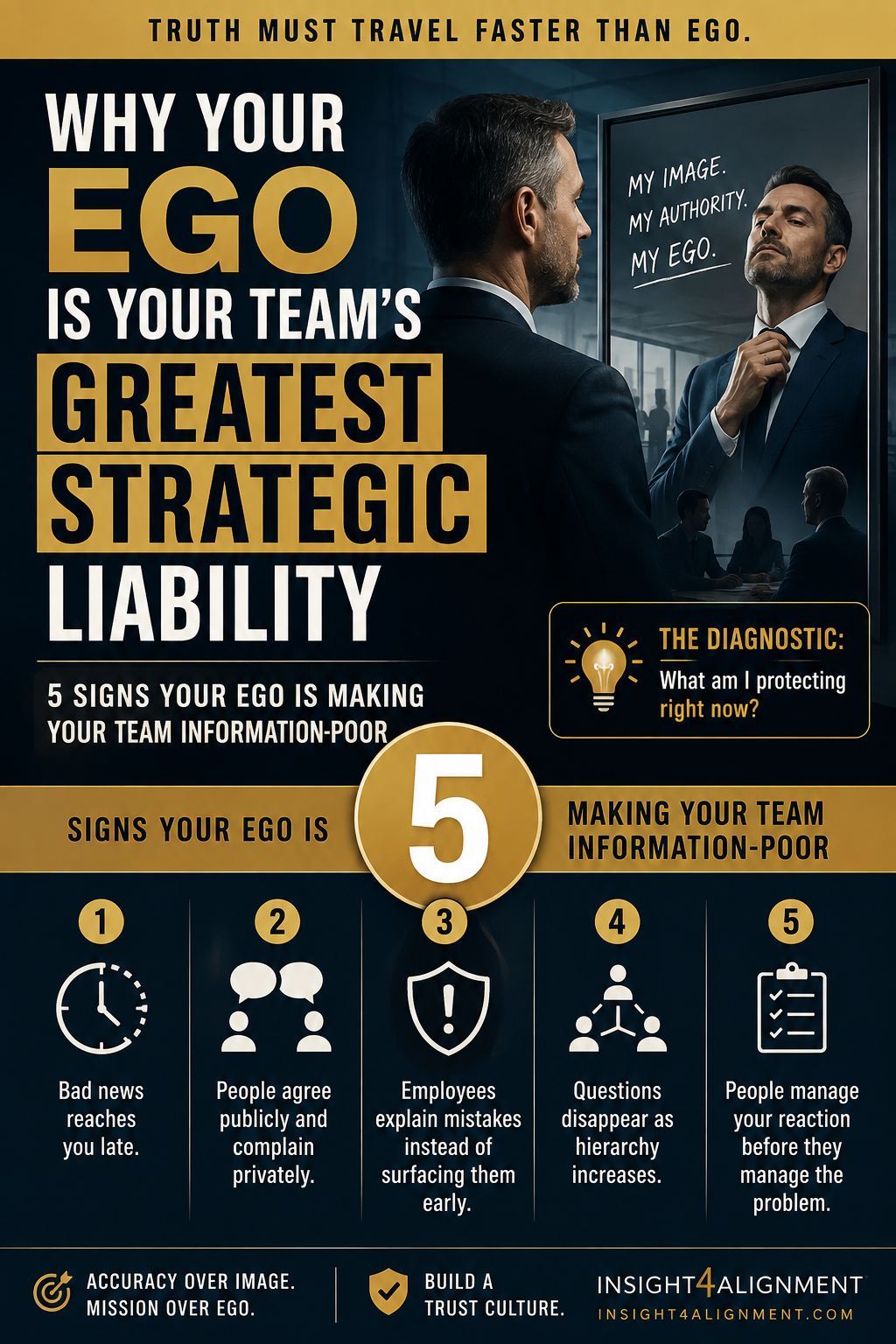
Why Your Ego Is Your Team’s Greatest Strategic Liability
Discover how unmanaged ego becomes a strategic leadership liability. This article reveals 5 signs your team is becoming information-poor and shows how humility, psychological safety, and grounded leadership build trust, accountability, and stronger performance.
5 Insights to Build a "Trust Culture"
1. Introduction: The High Cost of Being "Right"
In high-stakes leadership, we often mistake defensiveness for "standing our ground" or "maintaining high standards." In reality, professional defensiveness is not a personality trait; it is a strategic liability that induces "Information Poverty." When a leader’s primary focus shifts toward protecting their image, they inadvertently signal that the truth is too "relationally expensive" for their team to share.
To build a high-performing organization, leaders must move from Automatic Protection—the biological default of reacting to perceived threats—to Humble Presence. This presence is the secure middle ground between self-erasure and arrogance. It allows you to enter the "Grounded Leadership" quadrant: possessing high confidence in your abilities without the desperate need for superiority.
2. The "Information Poverty" Trap
Information Poverty is a high-risk state where critical facts, risks, and errors remain hidden because the culture makes them too costly to surface. If your team has to navigate your ego to tell you the truth, they will eventually stop trying.
"In high-stakes professional environments, unmanaged defensiveness is far more than a personality friction; it is a strategic liability that generates 'Information Poverty.'"
As a strategist, your goal is to ensure that truth travels faster than ego-protection. When leaders prioritize their professional image over the acquisition of truth, they effectively silence the team’s collective intelligence. If truth is expensive, your organization is poor.
3. The 10 Hidden Assets We Are Actually Protecting
Defensiveness is rarely about the project; it is a survival mechanism for specific "vulnerability targets." When we decouple our behavior from our identity, we reduce the "relational expense" of admitting errors. This isn't a moral failing; it’s mechanics. We become defensive when we perceive a threat to our:
Competence
Intelligence
Authority
Reputation
Status
Belonging
Control
Likability
Certainty
Expertise
By acknowledging these as assets we are biologically wired to protect, we can lower the cost of resolution. Admitting a mistake is no longer a threat to your worth; it is simply a move toward better data.
4. Decoding the Ego Protection Loop
The Ego Protection Loop follows a predictable pipeline: Trigger → Interpretation → Protection → Behavior → Team Impact.
The critical pivot point is Interpretation. When a challenge is interpreted as a threat to your worth, your brain shifts from collaboration to protection. Some might argue, "I don't have time to ask everyone for their opinion." But humility isn’t about consensus; it’s about knowing when a different perspective improves the quality of your decision. It allows you to address incompetence without unnecessarily diminishing the person.
Triggering Event: An employee questions a decision.
Defensive Script (Ego): "They don't respect my authority or my role."
Humble Script (Curiosity): "There may be something here I haven't considered."
Resulting Team Impact: Trust grows; truth moves upward.
Event: A colleague corrects a public error.
Defensive Script (Ego): "They are trying to make me look incompetent."
Humble Script (Curiosity): "Accuracy is more important than my image."
Resulting Team Impact: Problems are surfaced while they are small and fixable.
Event: A plan is challenged in a meeting.
Defensive Script (Ego): "They are undermining the project's success."
Humble Script (Curiosity): "What am I missing that they are seeing?"
Resulting Team Impact: Risks are vetted; decisions are reality-based.
5. The Cultural Audit: 6 Signs Your Protocol is Working
As a team moves toward a "Trust Culture," specific indicators emerge. These signs show that truth, dignity, and learning now outweigh ego preservation:
Earlier Problem Reporting: Risks and errors are surfaced while manageable, rather than being hidden until they escalate.
Accuracy Over Image: A collective prioritization of finding the "right answer" over the performance of "being right."
Reduction in "Underground" Gossip: Side-channel complaining and "parking lot meetings" are replaced by direct, humble communication.
Increased Questions: Team members prioritize active information-seeking over maintaining a facade of false certainty.
Shared Credit: Recognition moves naturally toward contributors rather than being hoarded at the top of the hierarchy.
Information Flow: Critical data moves upward without being filtered by the fear of a leader’s reaction.
6. The "Balanced Pause": Practical Tools for Grounded Leadership
To shift from defense to curiosity, you must master the Notice-Name-Reconsider-Choose model. This creates the "Balanced Pause":
Notice: Identify the physical sensation of being triggered.
Name: Explicitly identify which asset (e.g., status, expertise) you feel is under threat.
Reconsider: Question the intent—is this a threat to your worth or a contribution to the mission?
Choose: Select a response that prioritizes accuracy over protection.
Practice these "Humble Responses" to keep the flow of reality intact:
"Walk me through what you're seeing."
"What concerns you most?"
"Is there information I’m missing?"
"What part of the plan feels weakest to you?"
"What would you recommend we look at?"
The Strategist’s Insight: Humility does not dilute your decision-making authority; it improves the quality of the information you possess before you exercise it.
7. Conclusion: The Diagnostic Question
A true trust culture is not the absence of ego-driven triggers, but the development of the awareness necessary to choose a different response. Awareness is the prerequisite for professional choice.
As you navigate your next 30 days of leadership, interrupt the Ego Protection Loop with one diagnostic question: "What am I protecting right now?"
When you stop protecting your image, you finally become free to protect the mission.
Watch more: https://youtu.be/ChbM406083o
Join my Skool Community today: https://www.skool.com/alignspace-2699/about
Follow me on Facebook at: www.facebook.com/DanniTheInsightCoach/
ENTER THE DOORWAY INTO I4A: https://claude.ai/public/artifacts/888c15be-909d-4e92-a00a-72f5dbab3f6d

The High Cost of Distrust
Distrust and fear-based leadership can quietly damage workplace culture, reduce psychological safety, increase employee turnover, and create costly business consequences. When ego-driven management replaces trust, organizations risk losing talent, productivity, innovation, and long-term stability. Psychological safety is not only a leadership value; it is a strategic responsibility that protects people, performance, and organizational sustainability.
How Psychological Safety Quietly Protects Your Budget and Your Best People
Organizations love to measure what is visible: revenue, expenses, headcount, performance metrics, quarterly targets. However, some of the most expensive forces inside a company are not immediately visible. Distrust is one of them. Psychological safety is another. One quietly drains your budget. The other quietly protects it. Yet, many leaders underestimate both.
The Hidden Ledger: What Distrust Really Costs
Distrust rarely appears as a formal line item on a financial statement. It shows up elsewhere. It shows up in delayed decisions. In rework and duplication. In avoidance, silence, and second-guessing. In turnover,disengagement,burnout, and emotional exhaustion. In innovation paralysis. In compliance instead of contribution.
These are not “soft” issues. They are operational inefficiencies with measurable financial consequences.
A low-trust culture does not simply affect morale. It slows the system. It increases friction. It causes people to withhold ideas, protect themselves, avoid risk, and spend energy managing the room instead of moving the work forward.
That kind of culture is expensive.
Turnover: The Most Visible Cost of Distrust
Turnover is one of the clearest ways distrust becomes measurable. Replacing an employee can cost significantly more than the salary attached to the role, especially once recruitment, onboarding, lost productivity, training time, and knowledge transfer are included. For specialized, senior, or leadership roles, the cost rises even higher.
Consider a 50-person team that loses five employees in one year due to distrust, burnout, or psychological unsafety. If each departure costs the organization an estimated $120,000, the annual loss becomes: 5 departures × $120,000 = $600,000 That is $600,000 in one year, from one team, and that number does not include the deeper cultural ripple effect:
Lost institutional knowledge.
Disrupted team cohesion.
Onboarding drag.
Declining morale among those who remain.
Cultural instability.
A quieter workplace where people begin wondering whether they should leave too.
Turnover is rarely random. Often, it is a referendum on trust.
The Fear Tax: Productivity Loss in Low-Trust Cultures
When trust is low, people self-protect. They become careful. Guarded. Politically aware. Quiet in the meetings where their voice is needed most.
Self-protection is expensive because it diverts energy away from contribution. Instead of asking the hard question, people stay silent. Instead of naming the problem early, they wait until it becomes urgent. Instead of taking ownership, they seek permission. Instead of innovating, they avoid being wrong. This is the fear tax. It is the hidden cost an organization pays when employees spend their best cognitive and emotional energy managing risk instead of creating value.
If a 20-person team represents $2.5 million in annual payroll, even a 10% productivity loss caused by fear, friction, avoidance, or distrust equals: $250,000 lost annually. From one team. Multiply that across departments, and distrust becomes systemic.
Innovation Loss: The Most Expensive Cost of All
Innovation is not only a technical process. It is a psychological one. When psychological safety is low, people do not offer bold ideas in rooms where mistakes are punished. They do not challenge flawed assumptions in cultures where disagreement is treated as disloyalty. They do not take initiative when every move is monitored, criticized, or second-guessed.
When psychological safety is low, people withhold the very insight the organization needs. There is a creativity paralysis. In fact, people stop proposing new ideas. They stop challenging weak strategy. They stop experimenting. They stop telling the truth early enough. By the time leadership finally hears the truth, the cost has already grown. This is because innovation is not just a competitive advantage. It is a survival strategy. Distrust suffocates it.
Micromanagement: The Leadership Style That Bleeds Money
Micromanagement is not just a leadership preference. It is a cost center. It creates decision bottlenecks, slows execution, drains initiative, and teaches capable people to wait for permission instead of building ownership.
Over time, micromanagement produces:
Slow execution.
Learned helplessness.
Emotional fatigue.
Low ownership.
Reduced creativity.
Higher turnover.
A culture where people perform compliance instead of practicing contribution.
The irony is that micromanagement usually tries to prevent risk. However, in practice, it creates a larger one. It weakens the decision-making capacity of the people closest to the work. When leaders become the bottleneck, the entire organization pays for their fear.
Psychological Safety: The Most Undervalued Financial Asset
Psychological safety is often misunderstood. It is not about comfort. It is not about avoiding accountability. It is not even about creating a workplace where everyone agrees. Psychological safety is about capacity. It is the condition that allows people to tell the truth early, ask for help, name risks, offer ideas, admit mistakes, challenge assumptions, and stay engaged when the work becomes difficult.
Psychological safety strengthens:
Retention.
Engagement.
Creativity.
Accountability.Collaboration.
Speed of execution.
Quality of decision-making.
Psychological safety does not remove pressure. It increases the organization’s ability to move through pressure without collapsing into fear, silence, blame, or control. That makes it a strategic asset.
Retention ROI: What Safety Preserves
If an organization spends $1 million annually on turnover-related costs, even a modest improvement in retention can preserve hundreds of thousands of dollars. This is where psychological safety becomes financially visible. When people feel respected, heard, trusted, and able to contribute honestly, they are less likely to disengage, quietly quit, or leave.
Retention is not only about compensation. People will stay where they can breathe. People will remain loyal where they can grow. People will invest their interests, their passions, their strengths, and their values where their voice matters. People engage wholeheartedly where their contribution is not constantly filtered through fear. Psychological safety protects more than morale. It protects talent.
Productivity ROI: What Trust Releases
A culture of trust reduces friction, and friction is expensive. When trust is high, people spend less energy managing perception and more energy doing meaningful work. Decisions move faster. Communication becomes cleaner. Misunderstandings decrease. Ownership increases. Teams recover from mistakes more quickly. Leaders spend less time repairing damage and more time building direction.
On a $10 million payroll, even a 10–20% productivity improvement represents: $1–2 million in preserved value. That is not abstract culture work. That is organizational efficiency.
Innovation ROI: What Safety Makes Possible
Innovation is harder to quantify, but often more costly to lose. Psychological safety can be the difference between:
Being first to market or falling behind.
Solving a problem early or paying for it later.
Retaining top talent or watching them leave for healthier cultures.
Hearing the truth in time or discovering the damage too late.
The best ideas in an organization often live inside people who are waiting to see whether the room is safe enough to speak. If they love their workplace, and if they are invested in their place in the company and among the team, they will look for ways to deepen the experience of meaningful work. They will seek out ways and opportunities to use their time, energy and resources to add more value. Not because they are opportunistic and want to gain, but rather because they have already sown themselves into how they show up every day and they want to keep growing and experiencing that sense of meaningful work. It is the leaders in the room who set that temperature for inspiring work and nurturing creativity that can bring increase all around… or not. It is also the leader in the room that can shut that down quickly and deflate that sense of meaningful engagmeent.
The Leadership Equation: Trust = Efficiency
Trust reduces friction. Friction drains capacity.
Psychological safety is the relational infrastructure that keeps an organization moving with greater clarity, honesty, and speed. It supports faster decisions. Cleaner communication. Greater initiative. Stronger ownership. More accurate feedback. Better alignment.
When trust is high, organizations spend less time recovering from avoidable damage and more time creating meaningful results. On the contrary, when trust is low, the organization may still move — but with drag, and drag always costs something.
The Real Question for Leaders
The real question is not whether psychological safety matters. The real question is: How much is distrust costing your organization right now — in dollars, not theory? And equally important: How much is psychological safety already saving you, quietly and invisibly, every single day?
In reality, the truth is simple: Distrust is a financial liability. Psychological safety is a strategic asset. Leaders who understand this do more than build healthier cultures. They build stronger, more resilient, more profitable organizations — because they understand that trust is not separate from performance. Trust is part of the architecture that makes performance sustainable.
This is what so many managers, supervisors, and inexperienced leaders fail to recognize: when staying in a psychologically unsafe environment becomes more costly to a person than uprooting themselves, facing change, and investing the effort to find something healthier, the organization is already losing valuable talent. Even the way a person exits is often shaped by the need to protect their psychological safety. Long before they resign, they may already be planning their departure, working while distracted, and slowly disengaging from their full capacity. Not because they are lazy, irresponsible, or lacking productivity skills, but because they are trying to protect their nervous system, mental health, and sense of stability. By the time the organization notices, it may have already lost a key asset. That loss does not only affect the team. It can significantly cost the company, its shareholders, and even its customers.
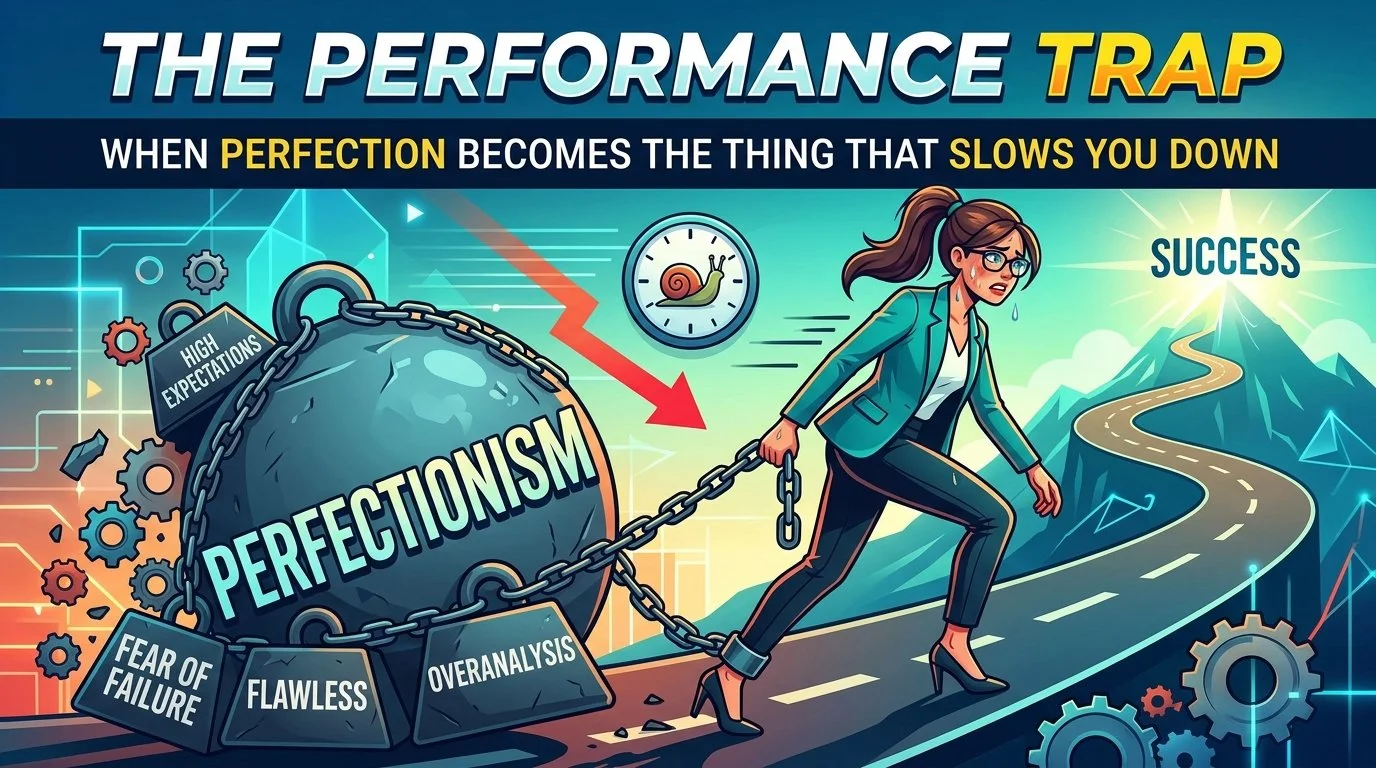
The Performance Trap
Perfectionism can quietly drain clarity, trust, and momentum. Learn how the performance trap keeps leaders stuck in self-judgment and how aligned leadership begins with internal ownership.
When Perfection Becomes the Thing That Slows You Down
There is a kind of leadership pressure that can look admirable from the outside. It looks like discipline. It looks like drive. It looks like high standards, sharp instincts, and a refusal to settle. Yet underneath it, there can be something far less noble and far more exhausting: a quiet dependence on pressure, a private fear of imperfection, an inner agreement that says your authority must be earned again and again through flawless execution. This is the performance trap. It is what happens when excellence stops being an expression of care and becomes a mechanism of self-protection. It is what happens when your drive is no longer rooted in purpose, but in the need to outrun your own self-criticism. While it may still produce motion, it does not produce peace. It does not produce spaciousness. It does not produce the kind of leadership that can breathe.
The lie beneath the striving
Many leaders have been taught to call this excellence. They have been taught that relentless perfection is the cost of entry. That constant self-pressure is proof of responsibility. That an unforgiving inner standard is what keeps them sharp, relevant, and worthy of the room they are in. However, often this is not excellence at all. It is fear in a tailored suit. It is self-doubt dressed up as professionalism. It is internal judgment wearing the language of ambition. It is a life built around avoiding the sting of your own disapproval. This is the executive lie: the belief that perfectionism is strategic, when in truth it is often defensive. The leader believes they are building authority, when in reality they are exhausting themselves trying to keep authority from collapsing.
When the inner world becomes a courtroom
One of the clearest signs of the performance trap is that your inner world no longer feels like a place of guidance. It feels like a place of trial. The mind becomes a courtroom. The inner critic becomes the loudest voice in the room, and every unfinished task, delayed decision, imperfect conversation, or missed detail becomes evidence. You may still look capable. You may still be achieving. You may still be admired. However, internally, your energy is being drained by a cycle of self-accusation.
This is the hidden friction so many leaders live with: not a lack of ability, but a constant internal drag. A grinding mental static. A tension that narrows perspective. A subtle emotional tax that makes even important work feel heavier than it should and because the mind is so busy managing self-judgment, it has less room for what leadership actually requires: discernment, creativity, courage, clarity, relationship, and the spaciousness to think beyond survival.
The alignment barrier
This is where the alignment barrier begins. An alignment barrier is the friction created when your outer efforts are no longer in harmony with your inner values. It is the distance between the leader you long to be and the internal patterns interrupting your ability to embody that leader fully. When this barrier is present, your leadership begins to leak energy. Not always visibly. Sometimes very quietly.
You work harder, but trust feels thinner.
You stay busy, but momentum feels stalled.
You remain productive, but deeply tired.
You keep holding more, but feel less steady.
This is because a mind burdened by self-defense cannot fully offer itself to aligned execution. Too much energy is being spent managing internal threat.
The mirror effect
What remains unresolved within a leader rarely stays contained there. This is one of the deepest truths of self-leadership: the atmosphere you live in internally will eventually shape the atmosphere you create externally. If you are harsh with yourself, that harshness often echoes outward. If your inner world is built on suspicion, pressure, and impossible standards, your leadership presence will often carry that same tone, even when your words sound measured. This is the mirror effect. We project onto others what we have not yet made peace with inside ourselves. A lack of compassion inward often becomes condemnation outward. A leader begins assuming the worst, not because others are always failing, but because their own inner architecture has taught them to interpret imperfection as danger. When that happens, trust begins to erode. The room becomes more careful. People brace instead of contribute. Feedback feels heavy. Collaboration becomes defensive. Culture tightens. The leader may think the issue is performance, but often the deeper issue is resonance.
Fear-driven performance versus purpose-driven commitment
There is a difference between action fueled by fear and action rooted in purpose. Fear-driven performance is exhausting because it is constantly trying to prove safety, worth, and competence. It burns energy quickly because the leader is not only doing the work, but defending against the possibility of being found lacking. Purpose-driven commitment feels different. It is still devoted. Still disciplined. Still clear, but it is no longer frantic. It is not trying to earn the right to exist. It is not building identity out of outcomes. It is not confusing control with strength. Purpose-driven leadership draws from something steadier: clarity, values, trust, resilience, service, conscious choice. This is where sustainable authority begins. Not in the constant maintenance of image, but in the quiet congruence of a leader whose inner and outer life are no longer at war.
The three shifts back to yourself
The way out of the performance trap is not more force. It is not another layer of pressure. It is not becoming harder on yourself in the hope that one day you will finally feel secure. The way out is a return. A return to self-leadership. A return to internal ownership. A return to authority that is not built on self-accusation. This return happens through three shifts.
1. The Responsibility Reclaim
This is the shift from being run by judgment to becoming the owner of thought. It begins when you notice the accusations in your mind and stop treating them as unquestioned truth. It begins when you recognize how much of your energy has been lost to self-justification, inner defensiveness, and the exhausting work of arguing with yourself. Ownership does not mean pretending everything is fine. It means telling the truth without turning the truth into a weapon. It means replacing: “I am failing” with “I need a clearer structure.” It means moving from emotional sting to practical clarity, and that shift is not small. It is foundational.
2. The Compassion-First Protocol
Compassion is not softness without standards. It is intelligent leadership of the inner world. When self-condemnation begins to loosen, something opens. There is more space for honesty. More room for repair. More capacity to see others clearly instead of reactively. A leader who has learned to extend inward compassion is more able to offer outward steadiness. They become less ruled by projection, less quick to assume incompetence, less likely to use pressure as their primary mode of influence. This is where trust culture begins: not in slogans, but in the emotional maturity of the leader.
3. Purpose Over Performance
Eventually, leadership must become anchored in something deeper than perfect results. When a leader is still addicted to perfection, their authority remains fragile. It rises and falls with outcomes. It needs external proof to feel stable. It hoards tasks, over-controls details, and struggles to release responsibility because imperfection feels personally threatening. However, purpose-rooted leadership is different. It is anchored in values. It can delegate without panic. It can move without needing certainty. It can remain steady even when the week is imperfect. This is the beginning of aligned execution: action without the drag of self-doubt, leadership without the constant ache of proving, authority that comes from congruence rather than applause.
Why small practices matter
Transformation is not always dramatic. Sometimes it begins with ten honest minutes. A small interruption. A replaced sentence. A single moment where you choose clarity instead of condemnation. A quiet act of self-leadership that breaks the old loop and reminds your mind that it no longer has to live in accusation. This is why the small practices matter. Not because they are simplistic, but because repetition rewires. A thought named becomes less powerful. A judgment interrupted loses some of its grip. A delegated task reveals the fear beneath the control. A chosen value begins to build a new inner architecture. The smallest moments of ownership can create the greatest openings.
The real question beneath it all
At some point, every leader must ask: What is this costing me?
Not only in output. Not only in time. But in peace. In trust. In energy. In creativity. In the culture forming around me. In the kind of leader I could become if I were no longer spending so much strength defending myself from myself. Because there is a cost to the performance trap. A cost to calling self-pressure strength. A cost to mistaking perfection for safety. A cost to remaining outwardly accomplished while inwardly crowded.
There is another way—to lead from clarity. To reclaim your inner authority. To move from fear-driven performance into purpose-driven presence. To become the kind of leader whose power is no longer fueled by pressure, but by alignment. That is the deeper invitation. It is not about more proving or using more force. Rather, it is a quiet return.
If this stirred something in you, pause there. You may not need more discipline. You may need relief from the inner system that keeps turning leadership into self-defense. The work of alignment begins by telling the truth about what pressure has been costing you. From there, a different kind of authority becomes possible.

Your Mind Is an Architecture
What if the struggles you face are not random, but structural? This article explores five powerful truths about inner architecture—how your passions, strengths, beliefs, resilience, and authentic voice shape the life you are building from the inside out.
5 Surprising Truths That Can Reframe the Way You Live
Introduction: The Unseen Structure Beneath Your Life
Have you ever had the feeling that your life is moving, but you are not really inside it?
For many people, life slowly becomes a pattern of obligations, reactions, responsibilities, and performance. From the outside, things may appear functional. You may be showing up, doing what is required, carrying what needs to be carried. But inwardly, something feels dim. There is a quiet ache. A sense of disconnection. A subtle grief that comes from living too far from yourself. This is not laziness. It is not failure. It is not a lack of gratitude. It is often the pain of misalignment. It is the inner cost of living in ways that do not fully honour your values, your design, your needs, or your truth. It is what happens when your life becomes structurally disconnected from the deeper architecture of who you are.
That is why I return again and again to this language of inner architecture. Your inner world has a structure. There is an unseen blueprint beneath the way you think, respond, decide, attach, avoid, endure, speak, and build. Your stories have structure. Your beliefs have structure. Your nervous system has patterns. Your values create design lines. Even your exhaustion often reveals something architectural: a misplacement, a strain point, a load you were never meant to carry in the way you have been carrying it. When we begin to see ourselves this way, self-development becomes far more honest. It stops being a project of “fixing what is wrong with me,” and becomes the sacred work of understanding how I have been built, what has shaped me, what is no longer sound, and what now needs to be restored, reinforced, or redesigned. This is not about becoming someone else. It is about becoming more structurally honest.
The five reframes below are not just ideas. They are invitations to return to yourself differently. To move from unconscious survival into conscious design. To stop living as a guest inside your own life and begin living as someone who knows they are allowed to participate in its construction. You are not here merely to manage your existence. You are here to inhabit it.
1. Your Passions Are Not Extras. They Are Part of Your Wiring.
One of the saddest things many people have learned is to treat what makes them come alive as if it were optional. Passion gets pushed to the edges. Joy gets postponed. Creativity gets treated like a reward for finishing all the “real” work. What once gave life colour becomes something we visit only when time permits, energy allows, or guilt loosens its grip. But the truth is this: what brings you alive is not frivolous. It is revealing. Your passions are not ornamental. They are not decorative pieces you add after the structure is complete. They are part of the internal wiring of your life. They are often the places where energy moves most cleanly through you. They restore current. They reintroduce vitality. They remind your nervous system that life is not only something to survive, but something to inhabit.
When passion is consistently exiled, the lights begin to dim. You may still function. You may still produce. You may still be responsible, dependable, and externally impressive. But internally, there is often a slow fading. Hope weakens. Creativity tightens. Resentment grows. Life begins to feel repetitive, mechanical, and emotionally underlit. This is why I do not view passion as indulgence. I view it as evidence.
Evidence of where life moves through you with energy.
Evidence of where your system comes into coherence.
Evidence of what restores you to yourself.
You were not designed to run only on pressure, duty, and depletion. You were not built to live on empty tasks and chronic override. There are things within you that switch the lights on. Honouring those things is not irresponsible. It is structurally wise, because when the current returns, you can finally see your life clearly enough to discern what else needs repair.
2. Your Strengths Are Not Accidents. They Are Features of Your Design.
So many people can tell you what is wrong with them in great detail. They can name their insecurities, their shortcomings, their weaknesses, their awkwardness, the ways they feel they fall behind, disappoint others, or fail to measure up. But ask them what is right about them—what is natural in them, strong in them, true in them—and suddenly there is hesitation. That hesitation is not humility. Often, it is the residue of having lived too long in deficit language. Many people have been trained to study themselves through the lens of correction rather than design. They learned to relate to themselves as a problem to solve instead of a structure to understand, and because of that, they often end up building lives around compensation rather than alignment.
But your strengths are not random. They are not lucky traits. They are not ego problems waiting to happen. They are part of your design. Your strengths reveal the places where energy tends to move through you with less friction. They reveal the ways you naturally perceive, process, contribute, create, lead, care, discern, or build. Some people carry depth naturally. Some carry strategy. Some carry pattern recognition. Some carry tenderness. Some carry courage. Some carry imaginative capacity. Some carry stabilizing presence. These are not mistakes in the blueprint. They are clues.
Of course, many of our strengths were mishandled by others before we learned how to steward them well. Leadership may have been called “too much.” Sensitivity may have been called weakness. Discernment may have been mistaken for resistance. Creativity may have been treated like impracticality, but being misunderstood does not erase design. It only means you may need to reclaim what was mislabeled.
There is a quiet authority that emerges when you stop apologizing for how you are built and start understanding how to live from it with maturity. You do not need to become everything. You do not need equal brilliance in every direction. You do not need to contort yourself into a blueprint that was never yours. You need only the courage to honour your design enough to build from it. That is where confidence becomes less performative and more grounded. That is where comparison begins to lose its grip. That is where belonging starts to become more precise. Once you begin to understand the features of your own design, you stop forcing yourself to thrive in spaces that were never built for who you are.
3. Your Limiting Beliefs Are Not Your Identity. They Are Old Programming.
Not everything that feels true is true. Some things feel true because they have been repeated often. Because they were learned early. Because they once protected you. Because they became familiar enough to feel foundational. This is the nature of limiting beliefs. They often function like hidden code running quietly beneath the visible surface of life. They shape reactions, expectations, relationships, boundaries, ambition, visibility, and self-permission. They tell you what is safe, what is dangerous, what you are allowed to hope for, what you should suppress, and what might happen if you fully become yourself.
Many of these beliefs are built around silent conditional statements:
If I am fully seen, I will be rejected.
If I speak honestly, I will lose connection.
If I try and fail, it will prove something about my worth.
If I rest, I am falling behind.
If I disappoint someone, I have done something wrong.
This kind of internal programming does not mean you are broken. It means you adapted. At some point, this coding likely made sense. It may have helped you survive emotionally, relationally, spiritually, or psychologically. It may have helped you stay attached, stay safe, stay small enough to avoid threat, or stay useful enough to feel needed, but survival code is not always life-giving code and what once protected you can eventually imprison you. This is why awareness matters so much. Because once you begin to notice the script, you create the possibility of interruption. And once interruption becomes possible, new design becomes possible.
I think this is one of the most liberating truths in inner work: you are not your first programming. You are not every belief you inherited. You are not every fear-based conclusion your nervous system once made. You are not the outdated code. You are the one becoming conscious enough to inspect it, and that changes everything. It reduces shame. It increases compassion. It gives language to patterns that once only felt like failure. It reminds you that your recurring struggle may not be a sign of defect, but a sign that an internal system is asking for revision.
You do not need to condemn yourself for old programming, but you do need to become honest enough to stop building your future on top of it.
4. Resilience Is Not Hardness. It Is Honest Flexibility.
Many people were taught a distorted version of strength. They were taught that resilience means suppressing emotion, pushing through exhaustion, carrying everything alone, staying productive under pressure, and remaining unshaken no matter the cost. They learned that falling apart is failure, that rest must be justified, and that needing support is somehow a sign of weakness, but that is not resilience. That is often survival performance. It may look strong from the outside, but inwardly it produces brittleness. The system becomes overextended. The body holds too much. The soul narrows. The nervous system adapts around chronic pressure. And eventually what looked like strength reveals itself as unsustainable self-abandonment.
True resilience has a different quality. It is not rigid. It is responsive. Real resilience bends without betraying itself. It feels impact without collapsing identity. It makes room for grief, fatigue, repair, recalibration, and support. It honours the fact that being human is not a flaw in the structure. A healthy building is not one that never encounters weather. It is one designed to remain sound through it.
The same is true for you. Resilience does not mean becoming untouchable. It means becoming rooted enough, flexible enough, and self-aware enough that life’s pressure does not permanently disconnect you from yourself. This kind of resilience is gentler, but not weaker. In fact, it is stronger because it is sustainable. It allows you to recover instead of merely endure. It allows you to tell the truth before your body has to scream it. It allows rest to become wisdom instead of reward. It allows support to become part of the design rather than evidence that the design has failed.
I do not believe the goal is to become harder and harder. I believe the work is to become more deeply aligned with what is true, so that when pressure comes, you know how to return without losing yourself inside it. That is resilience. Not silent self-sacrifice. Not polished over-functioning. Not performing invincibility, but a flexible, honest strength that protects the architecture of your life.
5. Your Authentic Voice Is Not a Threat. It Is a Load-Bearing Beam.
There comes a point in many people’s lives when they realize they have spent years editing themselves for survival. Softening the truth. Swallowing the no. Minimizing desire. Withholding discomfort. Performing agreement. Remaining agreeable enough to preserve connection, acceptance, peace, or safety. This performed self can become so familiar that it starts to feel like identity, but it is not always identity. Sometimes it is adaptation and adaptation, while understandable, can become deeply costly when it requires you to keep abandoning the very voice that carries your integrity.
Your authentic voice is not merely a preference. It is structural. It holds weight. It is the part of you that remembers what matters, what hurts, what is misaligned, what you long for, what you can no longer tolerate, what you actually mean, what you deeply know, and where your boundaries belong. Without that voice, life may still look stable, but it will not feel safe to live in.
You may build a version of life that earns approval. You may become highly skilled at being palatable. You may learn how to appear composed, thoughtful, capable, spiritual, nice, or strong, but if your real voice is missing from the structure, there will always be an internal instability. Because appearance is not the same as integrity. This is why reclaiming your voice is not about becoming harsh, reactive, or oppositional. It is about restoring structural honesty. Each truthful sentence becomes a form of repair. Each boundary becomes reinforcement. Each honest admission becomes a beam returned to its rightful place. Each moment of self-honouring tells your nervous system: I am allowed to exist here truthfully, and something powerful happens when that begins. Self-respect deepens. Internal noise softens. People-pleasing loses some of its urgency. You become less available for misalignment. You feel less like a guest in your own life because the structure is finally beginning to support the real you.
Your authentic voice is not too much. It is not a liability. It is not what makes the structure unstable. It is one of the main things that makes it sound.
Conclusion: You Are Not Stuck With the Structure as It Was
You are not just a life that happened to you. You are not only the product of old environments, inherited scripts, relational wounds, survival adaptations, or outdated beliefs. Those things may have shaped parts of the structure, yes. But they do not have the final word on what gets built now. You are allowed to become conscious. You are allowed to inspect what no longer feels sound. You are allowed to repair what has been strained. You are allowed to release what was never yours to carry. You are allowed to build in a way that feels more honest, more spacious, more alive.
That is what alignment asks of us. Not perfection. Not permanent mastery. Not a polished, finished self, but a willingness to return. To return to what is true. To return to what is structurally honest. To return to your design. To return to your voice. To return to your life before performance becomes your landlord again. Alignment is not a fixed state. It is a practice of returning, and every small, honest choice you make in that direction matters.
So perhaps the question is not, “How do I become someone else?” Perhaps the real question is: What is one honest shift I can make today that brings the structure of my life back into deeper alignment with who I truly am?

The Foundation of Authority
True authority begins within. Discover how self-judgment drains clarity, weakens leadership, and why becoming an owner of thought is the foundation of aligned, high-trust leadership.
Becoming an Owner of Thought
There is a kind of leadership that looks strong from the outside and feels crowded on the inside. It is polished. Capable. Dependable. Disciplined. Yet beneath it, there is often an invisible strain. A pressure. A tightening. A silent agreement that says:
I must stay ahead of my own criticism.
I must keep proving I deserve to be here.
I must not slow down long enough to feel what this is costing me.
This is one of the hidden sorrows of high performance. Excellence begins as devotion, but over time it can become something else. It can become an atmosphere of internal demand so constant that it no longer feels chosen. It just feels normal, and when that happens, leadership begins to lose its spaciousness. It becomes less like stewardship and more like survival. What many call discipline is sometimes a quieter kind of fear. Not always fear of failure in the obvious sense. Sometimes it is the fear of the voice within. Fear of the inner verdict. Fear of what might rise to the surface if achievement is no longer there to outrun self-judgment.
This is the performance trap. It convinces leaders that perfection is strategic when often it is simply protective. It creates a static in the mind — a grinding internal friction where energy that could have become clarity, vision, and wise action is instead spent on self-reproach, self-monitoring, and invisible defense. This is where authority begins to weaken. Not because the leader lacks intelligence. Not because they lack skill. Simply because their inner world has become too adversarial to support sustainable power.
The mind can become a place of occupation
There is a difference between having thoughts and being governed by them. Many leaders live under an internal atmosphere they have never truly questioned. They do not merely notice judgment; they live inside it. Their mind becomes a place of constant review, where every misstep is magnified, every delay is interpreted personally, and every imperfection is quietly handed to the inner critic as evidence.
This is what it means to become a victim of judgment. Not helpless in the external sense, but inwardly overrun. The mind runs the person. The person reacts rather than directs. The inner life becomes defensive rather than creative. This has consequences because the energy required for strategic leadership is the same energy often being consumed by excuses, rehearsals, justifications, and self-accusation. Outwardly, the leader may appear composed, but inwardly, they are spending precious cognitive and emotional resources trying to survive their own thoughts. This is why ownership matters so deeply—not as a slogan and not as self-help language, but as inner governance.
Becoming an owner of thought
To become an owner of thought is to reclaim the inner landscape. It is to stop handing over authority to every condemning sentence that rises in the mind. It is to recognize that you do not have to justify your existence to your own internal critic. It is to move from being ruled by your thoughts to taking responsibility for the atmosphere they are creating. This is the beginning of real authority. Because authority is not first built in the boardroom. It is built in the unseen places. In the pause between thought and reaction. In the choice to tell the truth without turning it into an accusation. In the decision to replace inner hostility with grounded clarity.
Ownershipdoes not mean never feeling judgment. However, it does mean no longer bowing to it. It means reclaimingmental energy that has been leaking through the cracks of self-criticism. It means ending the exhausting cycle of defending yourself against yourself. It means beginning to see clearly how much of your leadership has been shaped by internal friction you were calling “normal.”
There is relief in this. A grounded relief. A spacious relief. The kind of relief that comes when your mind no longer feels like an opposing force.
Awareness is the first doorway
Ownership begins with awareness. Not dramatic awareness. Not performative awareness. Just honest awareness. The kind that sits down for a moment and says:
What have I been saying to myself?
What weight have I been carrying as if it were wisdom?
What judgments have I allowed to harden into identity?
This is why practices like the Judgment Audit matter. They are not about pretending everything is fine. They are not about dressing pain in polished language. They are about interrupting the self-accusing cycle and bringing the mind back into reality.
When a leader shifts from “I wasted the morning” to “My calendar needs protected deep-work space,” something important happens. The sting is removed. The fog begins to clear. The problem becomes workable.
This is the quiet power of factual honesty. It does not shame. It clarifies, and clarity is one of the purest forms of self-respect.
What is unowned within us spills outward
Leadership is never just internal, but it always begins there. What remains unexamined inside us eventually shapes how we interpret others. The frustrations we carry toward colleagues, teams, or environments are often connected to standards, pressures, and unresolved condemnations already active within us.
This is why projection is so costly. It drains trust. It distorts perception. It turns leadership into a subtle transfer of internal friction.
If I am impatient with my own humanity, I will likely have less patience for yours. If I interpret my own missteps through condemnation, I may quietly do the same to those I lead. If my inner world is built on pressure, my leadership presence will carry that pressure, even when my words sound polished. This is why ownership must come before grace, not because compassion is secondary, but because compassion cannot be sustained where ownership has been avoided.
Ownership precedes purpose
There is a sequence to aligned leadership. We do not move into purpose by skipping over responsibility. We do not build a trust culture by ignoring the inner architecture that keeps producing distrust. We do not lead others with spaciousness while remaining inwardly ruled by condemnation.
Ownership comes first. It is the first act of mature authority. Before purpose can become embodied, the judgment cycle must be interrupted. Before high-trust communication can exist, blame must lose its grip. Before a leader can extend the benefit of the doubt to others, they must stop weaponizing every imperfection against themselves. This is the deeper logic of alignment. Not performance first. Not image first. Not pressure first. Ownership first, because when ownership is present, purpose can finally rest on something steadier than fear.
The cost of stopping here
There is always a cost to leaving this work undone. A cost to continuing as though self-pressure is a strength. A cost to living as though inner criticism is the price of excellence. A cost to building leadership on a foundation that exhausts the very person trying to hold it all together. The cost is not only personal exhaustion. It is the loss of clarity. The loss of energy. The loss of trust that could have been cultivated through a more spacious presence. The loss of the kind of leadership that does not merely get results, but builds environments where people can breathe, contribute, and grow.
There is another possibility. It is the possibility of reclaiming your authority. To become an owner of thought. To let your inner world become less hostile and more honest. To move from self-defense into self-leadership. To lead not from the frantic maintenance of performance, but from the grounded steadiness of alignment. This is the true foundation of authority. It is not force. It is not perfection. It is not self-accusation. It is ownership, and from that place, purpose becomes possible.
If this stirred something in you, pause there. You may not need more pressure. You may need a different relationship with your own mind. The work of authority begins within. If you are ready to reclaim the energy lost to self-judgment and build leadership from a more aligned foundation, this is where the return begins.
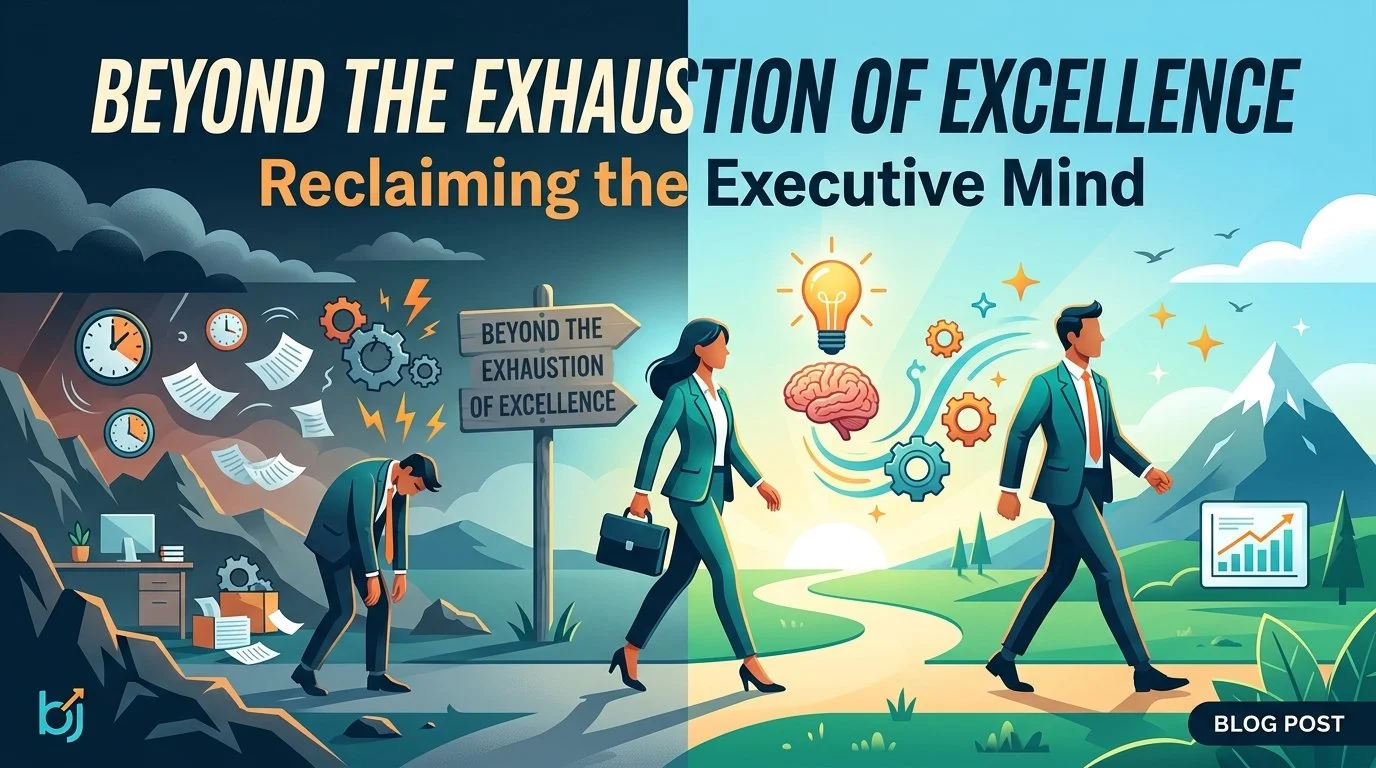
Beyond the Exhaustion of Excellence
Many leaders are exhausted not by lack of skill, but by the pressure of self-judgment. Explore how reclaiming the executive mind restores clarity, alignment, and sustainable authority.
Reclaiming the Executive Mind
There is a kind of exhaustion that does not come from doing too little. It comes from carrying too much. Too much pressure. Too much internal demand. Too much responsibility filtered through the belief that your value must always be proven through performance. This is the exhaustion many leaders know well, though few name it honestly. It is the fatigue of being outwardly capable and inwardly crowded. The fatigue of appearing composed while your inner world is bracing. The fatigue of leading from a mind that has forgotten how to rest inside itself.
For many high-capacity people, excellence begins as devotion. It begins as care. As a responsibility. As a desire to do what is right, to steward well, to offer something meaningful and strong, but somewhere along the way, excellence can lose its innocence. It can stop being an expression of integrity and become a form of self-surveillance. It can become a way of staying safe. A way of avoiding criticism. A way of outrunning the ache of not feeling like enough, and when that happens, excellence no longer feels clean. It feels heavy. It becomes less like leadership and more like maintenance. Less like vision and more like vigilance. Less like alignment and more like an internal war.
The mind can become a courtroom
There is a moment many leaders know, though they may not have language for it. The meeting is over. The room is quiet. The day has not gone badly, and still, something inside remains tense. The body does not unclench. The mind does not soften. There is no arrival because the real meeting is still happening internally. The mind has become a courtroom. The inner life has become a place of accusation, and instead of receiving your own humanity with honesty, you cross-examine it. This is one of the hidden costs of self-critical leadership: you may look composed from the outside while inwardly living under relentless review. In that state, your mental energy is no longer free for imagination, discernment, creativity, or steady presence. It is consumed by internal friction. By rehearsing what should have gone better. By tightening around what could go wrong. By managing yourself from suspicion rather than trust. This is not a sustainable authority. This is a depletion in sophisticated clothing.
When the mind runs the leader
One of the most important shifts in leadership is learning to notice when you are no longer leading your mind, but being led by it. This is what I would call becoming a victim of judgment. Not because you are weak and not because you are passive, but because your thoughts are no longer serving your deeper authority. They are ruling it. You are reacting inwardly instead of directing inwardly. You are defending yourself internally instead of building yourself internally. You are spending precious energy explaining, justifying, rehearsing, and accusing rather than creating. This matters because leadership is shaped long before it becomes visible. Before there is culture, there is consciousness. Before there is communication, there is internal narrative. Before there is trust in the room, there is trust—or distrust—within the leader. A leader whose mind has become hostile terrain will eventually build that tension into the atmosphere around them.
Ownership is the first act of grace
There is a sequence to aligned leadership. We do not move straight from exhaustion to empowerment by sheer force of will. We move through ownership. This is why internal responsibility must come first. You cannot extend sustainable grace to others while refusing to take responsibility for the atmosphere of your own mind. You cannot build a trust culture externally while living in condemnation internally. You cannot offer spacious leadership from an overcrowded inner world. This is not about blame. It is about authorship. It is about recognizing that if your thoughts are shaping your leadership, then your relationship to your thoughts is not a side issue. It is foundational architecture. This is where self-leadership becomes sacred work. Not dramatic. Not loud, but sacred in the truest sense: the quiet reclaiming of what has been governing you. The moment a leader stops outsourcing their inner life to fear, self-accusation, and inherited pressure, they begin to return home to themselves, and from that place, leadership becomes less performative and more congruent.
The mirror effect is always active
How we judge ourselves becomes the blueprint for how we judge others. This is one of the hardest truths, and one of the most liberating. If your inner voice is harsh, impatient, suspicious, or impossible to satisfy, those qualities do not stay contained inside you. They move outward. They shape tone. They affect timing. They influence how mistakes are interpreted, how pressure is transmitted, and how safe people feel in your presence. This is the mirror effect, and this is why the work of alignment is never merely personal. When a leader is living beneath the weight of self-judgment, the team feels it. Not always through words. Often through atmosphere. People begin to brace. Creativity narrows. Trust weakens. The room becomes careful instead of alive. The leader may believe the problem is pace, efficiency, or standards, but often the deeper issue is resonance. The culture is absorbing what the leader has not yet healed.
The alignment barrier
There is a name for this friction: the alignment barrier. It is the distance between your values and your operating system. The gap between the leader you intend to be and the internal patterns interrupting your ability to embody that intention. This barrier is not always dramatic. Sometimes it is subtle. It looks like hesitation where there should be movement. It looks like over-control where trust is needed. It looks like exhaustion that no amount of sleep seems to fix. It looks like a strategic delay, not because the path is unclear, but because some part of you is still waiting for permission to move without perfection. That is the ache beneath so much stalled momentum: not lack of vision, but lack of internal spaciousness. When your inner life is crowded with criticism, even wise action can feel emotionally expensive.
The return to sustainable authority
The way forward is not more force. It is not another layer of pressure. It is not a harsher discipline. It is a return. A return to internal ownership. A return to compassionate clarity. A return to purpose that is no longer chained to perfection. This return happens through three essential shifts.
1. The Responsibility Reclaim
This is the shift from being ruled by judgment to becoming the owner of thought. It is the decision to stop treating every internal accusation as truth. To notice the voice of condemnation and interrupt its authority. To recognize that self-judgment is not the same thing as wisdom. Ownership begins when you stop saying, “This is just how I am,” and begin asking, “What is governing me right now?” That question alone can change a life, because once you see the thought, you can work with it. Once you name the pattern, you can disrupt it. Once you stop merging with the accusation, you begin to recover your agency.
2. Compassion-first leadership
Compassion is not softness without standards. It is the refusal to weaponize awareness against yourself or others. It is mature leadership of the inner world. When you begin meeting yourself with compassionate clarity, something extraordinary happens: you stop wasting so much energy on resistance. You stop collapsing every mistake into identity. You stop turning every imperfection into evidence of unworthiness, and because your inner world becomes less hostile, your outer leadership becomes more spacious. You listen better. You interpret more carefully. You assume less. You create room for truth without making fear the host. This is the soil of a trust culture.
3. Purpose over performance
Eventually, leadership must outgrow the need to be impressive. It must become rooted in something steadier. Purpose-rooted authority does not depend on flawless execution to feel secure. It is anchored in values deeper than outcome—clarity, trust, courage, integrity, resilience. This is where leadership becomes sustainable. No longer a performance to maintain. No longer a fragile identity project. No longer a constant attempt to prove your right to be in the room. Instead, it becomes a way of inhabiting the room. Steady. Clear. Responsive. Alive.
Small interruptions can restore great power
Transformation does not always arrive through a dramatic overhaul. Sometimes it arrives through interruption. A ten-minute pause. A truthful question. A replaced sentence. A small act of internal honesty that breaks the spell of self-accusation. This is why short, disciplined practices matter. They teach the mind that it does not have to keep circling the same wound. They teach the nervous system that clarity is possible. They teach the leader that agency can be reclaimed in real time. Not someday. Not when life becomes less full. Now. Sometimes the most powerful shift is not dramatic at all. It is simply this: the moment you stop rehearsing your insufficiency and start returning to what is true.
The real question
At some point, every leader must ask themselves: What is this pattern costing me? Not only in output. Not only in time, but in aliveness. In trust. In peace. In presence. In the kind of leadership I could embody if I were no longer burning energy on inner war, because there is a cost to staying in the performance trap. A cost to living as though perfection is protection. A cost of confusing self-pressure with strength. A cost to remaining brilliant on the outside while depleted on the inside, and there is also a different possibility. To come home to yourself. To reclaim the executive mind from fear. To lead not from internal strain, but from alignment. To become the kind of leader whose authority is not built on pressure, but on presence. That is a different kind of power. And it lasts.
If this stirred something in you, do not rush past it. Sometimes the next shift in leadership is not found in more effort, but in deeper honesty. If you are ready to name the hidden friction, reclaim your inner authority, and lead from a more aligned place, this is the work. Not performance. Not proving, but returning.
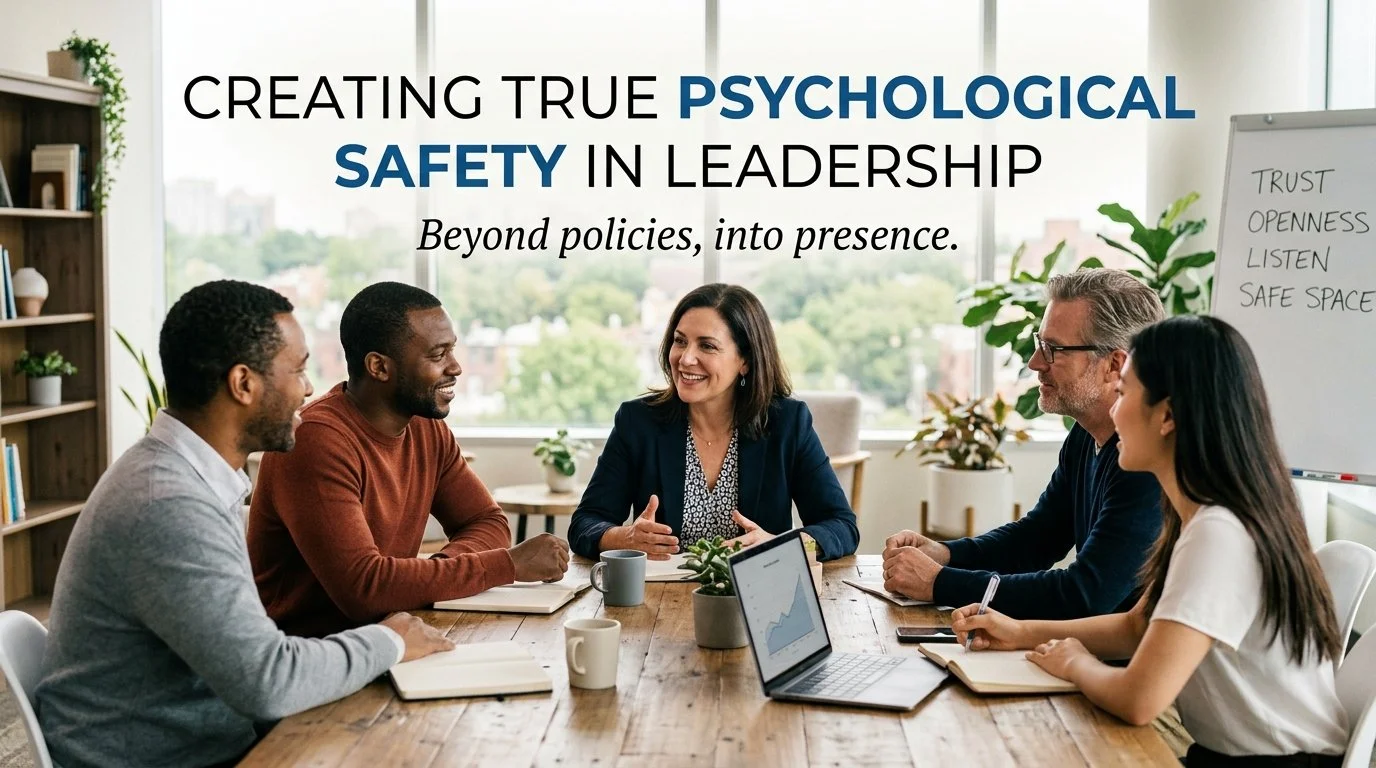
Creating True Psychological Safety in Leadership
Psychological safety has become one of the most talked-about concepts in leadership today. Yet despite its popularity, many organizations still struggle to create it in a way that is real, sustainable, and felt by their people. Why? It is because psychological safety is often treated as a policy or initiative, rather than a relational experience.
True psychological safety is not created through statements or training sessions alone. It is created through the daily posture of leadership—how a leader listens, responds, sets boundaries, and holds space for others.
Beyond policies, into presence
Psychological safety has become one of the most talked-about concepts in leadership today. Yet despite its popularity, many organizations still struggle to create it in a way that is real, sustainable, and felt by their people. Why? It is because psychological safety is often treated as a policy or initiative, rather than a relational experience. However, true psychological safety is not created through statements or training sessions alone. It is created through the daily posture of leadership—how a leader listens, responds, sets boundaries, and holds space for others. At its core, psychological safety is not about comfort. It is about trust. Too often, comfort has taken over the control center of how leaders define their culture.
What Psychological Safety Actually Requires
Leaders who create environments of true psychological safety consistently demonstrate:
Presence before reaction
They listen to understand, not to fix or control.Clarity over ambiguity
Expectations and standards are communicated with respect and consistency.Boundaries without punishment
Accountability is upheld without shame or fear-based control.Respect for emotional reality
People are allowed to express uncertainty, challenge ideas, and be in process.Consistency in conduct
Trust is built through repeated, aligned behavior—not occasional effort.
Psychological safety is not the absence of tension. It is the presence of relational integrity within tension.
Why Most Leadership Approaches Fall Short
Many leaders attempt to create safety by being more agreeable, more accommodating, or less directive. However, safety does not come from being “nice.” It comes from being clear, grounded, and trustworthy. Without structure, safety becomes fragile. Without presence, safety becomes performative. What is needed is a framework that helps leaders understand how their internal state and relational behavior shape culture.
The Role of Relational Leadership
This is where the Relational Leadership Diagnostic becomes essential. The diagnostic introduces leaders to a deeper question: How am I showing up in relationships—and what is that creating in others? Through this lens, leaders begin to see that culture is not built through strategy alone, but through:
Posture
Tone
Consistency
Awareness
Relational intelligence
This is the foundation of trust.
Introducing the Trust Culture Foundations Program
The Trust Culture Foundations Program was designed to help leaders move beyond theory and into applied relational leadership. This program equips leaders with the awareness and tools to:
Recognize how their leadership presence impacts trust
Develop clarity without losing connection
Lead conversations with integrity and emotional intelligence
Create environments where people can contribute fully without fear
It bridges the gap between intention and experience—because culture is not what leaders intend. It is what people consistently experience.
An Invitation to Lead Differently
If you are committed to building a culture where people feel safe to think, contribute, and grow, the work begins with awareness. We invite you to begin with the Relational Leadership Diagnostic and explore how your leadership presence is shaping your environment. From there, the Trust Culture Foundations Program will guide you into a deeper, more sustainable way of leading.
Psychological safety is not something you install. It is something you embody, and when leaders embody trust, culture follows.
Watch the Relational Leadership Diagnostic video here: https://youtu.be/hualmDF8Qv4.
Take the Trust Culture Foundations course for free by joining the AlignSpace Presence Community on Skool. The course is accessible through the Community Classroom.
Link: https://www.skool.com/alignspace-2699/about
Let’s connect!
Click on this link to learn more about Trust Culture Foundations: https://youtu.be/9emjx1p7LOo
When Curiosity Falls Silent
There once was a woman who had always believed herself to be a seeker. She asked questions. She read widely. She listened carefully to others. Curiosity had always felt like a companion walking beside her. However, over time, something changed. This wasn’t a sudden change. It was not dramatic. It was a change that came quietly.
Little by little, she began to notice that she no longer asked the same questions she once had. When someone spoke, she found herself finishing their sentences in her mind before they were done. When a new idea appeared, she compared it quickly to what she already believed. When conflict arose, she felt an urge to explain, defend, or correct rather than explore.
At first she told herself she was simply becoming wiser. After all, experience teaches us things. Surely, wisdom means being more certain. But something inside her felt tight. Conversations began to feel predictable. People seemed easier to categorize. Even the world felt smaller than it once had.
One evening, while walking along a quiet trail, she noticed an old woman sitting beside the path. The woman seemed calm, almost luminous in the fading light. The traveler stopped and greeted her.
After a moment of silence, the old woman asked gently, “Tell me, what question are you living inside these days?”
The traveler paused. She had many answers, but suddenly realized she could not name a single real question. She spoke instead about the problems she had been thinking about, the opinions she had formed, and the things she had concluded.
The old woman listened patiently. Then she asked again. “But what question is still alive in you?”
The traveler felt something shift. She realized that the voice inside her mind had been giving answers for a long time… but had stopped asking questions. Curiosity had not disappeared because the world had become simple. It had disappeared because certainty had become comfortable.
The old woman smiled kindly. “Certainty can feel safe,” she said. “But curiosity is what keeps the soul awake.”
The traveler stood quietly for a moment. She looked at the path ahead of her. For the first time in a long while, she did not feel the need to explain it, define it, or decide exactly where it would lead. She simply wondered. And in that wondering, something in her loosened. The world felt wide again.
Reflection
Where in your life has certainty replaced curiosity?
Where have your conclusions become stronger than your willingness to explore?
What question might be waiting quietly inside you, asking to be heard again?
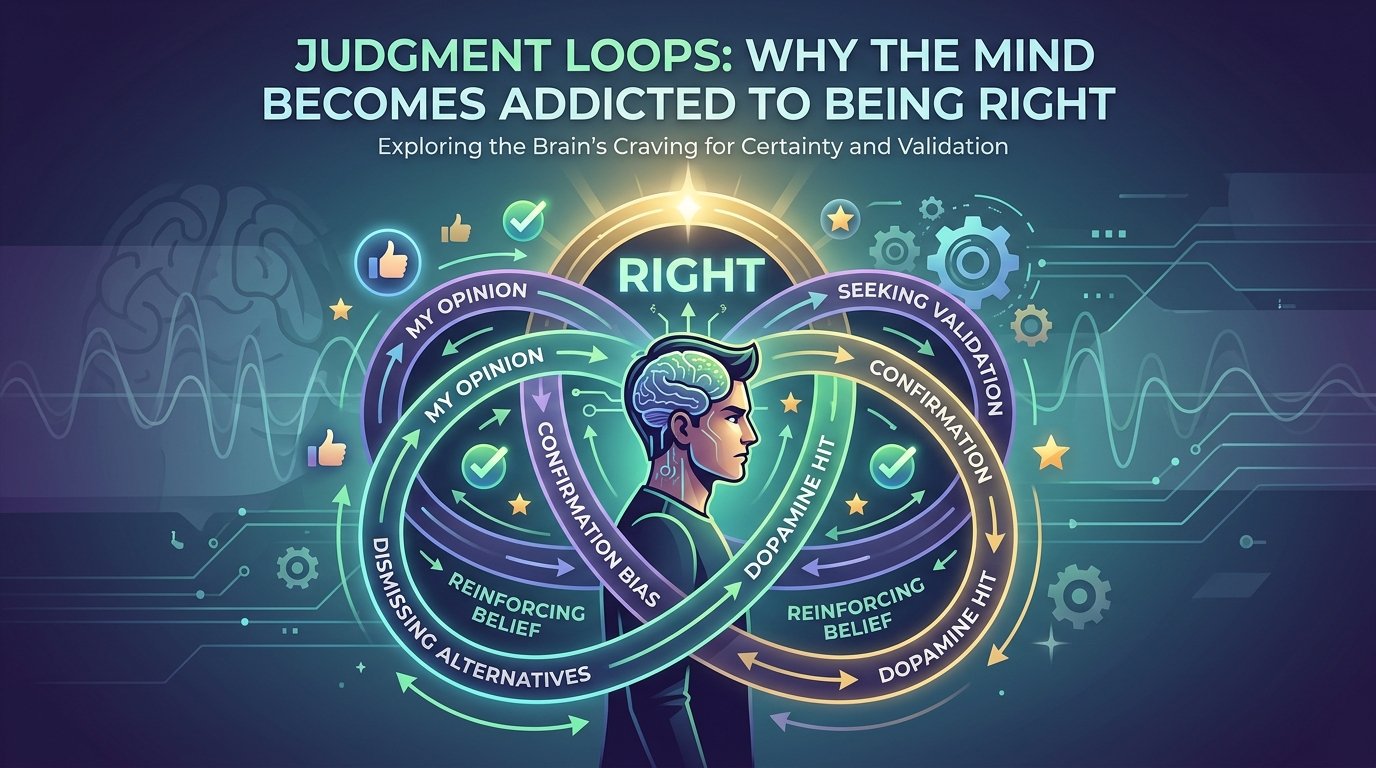
Judgment Loops: Why the Mind Becomes Addicted to Being Right
When the mind becomes attached to being right, it stops seeking truth and starts protecting identity — creating a psychological loop that fuels conflict, anxiety, and disconnection. At first glance, judgment feels like clarity. We see something and immediately label it: right or wrong, wise or foolish, acceptable or unacceptable. The mind feels certain. Stable. In control. However, beneath that certainty is often something much deeper — a psychological loop.
Why Certainty Feels So Good — and Costs So Much
When the mind becomes attached to being right, it stops seeking truth and starts protecting identity — creating a psychological loop that fuels conflict, anxiety, and disconnection. At first glance, judgment feels like clarity. We see something and immediately label it: right or wrong, wise or foolish, acceptable or unacceptable. The mind feels certain. Stable. In control. However, beneath that certainty is often something much deeper — a psychological loop.
Judgment is not always about truth. Very often, it is about identity protection. When our beliefs become fused with our sense of self, disagreement begins to feel like a threat. Instead of remaining curious, the mind begins defending its position. It gathers evidence, rejects opposing views, and reinforces the same conclusions over and over again.
This is what I call a Judgment Loop. A judgment loop is a cognitive pattern where the mind repeatedly seeks confirmation of its own correctness in order to stabilize identity and reduce internal uncertainty. Over time, the loop becomes addictive. Not because being right matters — but because certainty feels safe. The problem is that certainty can quietly replace awareness. And when awareness disappears, growth stops.
Key Insight
In the language of Alignment Architecture, judgment loops distort several internal structures at once:
• Thought Architecture becomes rigid
• Identity Architecture becomes defensive
• Dignity Architecture becomes conditional
• Trust Architecture begins to fracture
The result is a mind that feels powerful — but is actually trapped.
Freedom returns when curiosity replaces certainty.
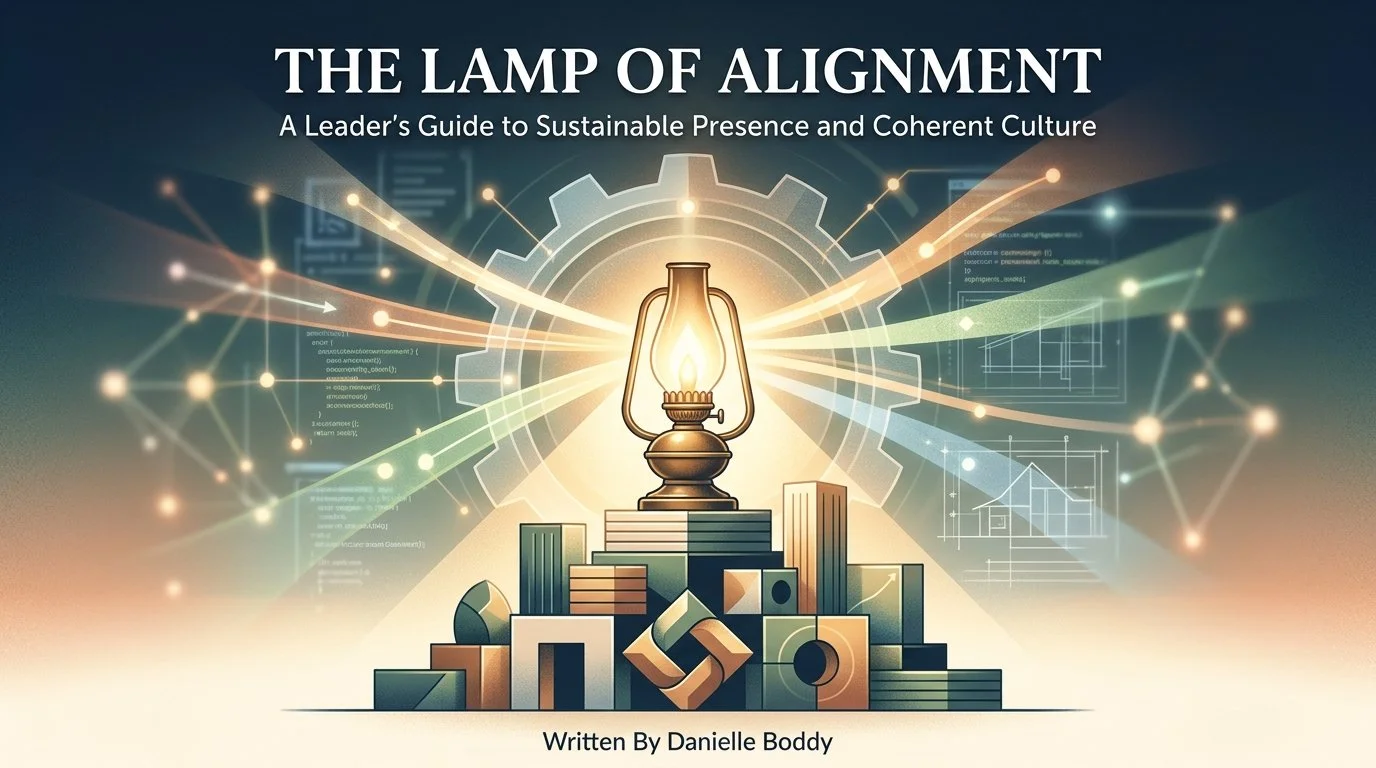
The Lamp of Alignment
Burnout is rarely a productivity problem. More often, it is a signal that something deeper has fallen out of alignment. Modern organizations are frequently designed around pressure, urgency, and measurable output. While these forces can produce short bursts of performance, they are not sustainable foundations for human vitality or meaningful work. Over time, teams that operate under constant pressure begin to experience depletion, fragmentation, and disengagement.
A Leader’s Guide to Sustainable Presence and Coherent Culture
Introduction
From Burnout to Alignment
Burnout is rarely a productivity problem. More often, it is a signal that something deeper has fallen out of alignment. Modern organizations are frequently designed around pressure, urgency, and measurable output. While these forces can produce short bursts of performance, they are not sustainable foundations for human vitality or meaningful work. Over time, teams that operate under constant pressure begin to experience depletion, fragmentation, and disengagement.
Insight4Alignment approaches leadership from a different premise. Human beings do not thrive under endless performance pressure. They thrive when the internal architecture of identity, dignity, trust, and presence is coherent. When that internal structure is aligned, individuals bring clarity, creativity, and resilience to their work. Teams become not only capable of producing results, but also capable of sustaining meaningful contribution over time.
At the heart of this approach is a guiding metaphor: The Lamp of Alignment. This lamp represents the living vitality of a team.
Within this metaphor:
The Flame represents the team’s energy, focus, and creative capacity.
The Oil represents shared wisdom, values, and relational trust.
The Wick represents the structures and systems that channel energy into meaningful work.
A healthy organization learns how to tend this lamp so that the flame can burn brightly without burning out. The first step in doing so is recognizing that burnout is not simply exhaustion. It is often a symptom of misalignment.
1. The Core Principle
Alignment Creates Coherence
Burnout frequently emerges when there is a gap between what people believe matters and what their work actually requires them to do. When values and actions diverge, people experience internal friction. Over time, this frictionbecomes fatigue.
Alignment restores coherence. In an aligned organization, the inner world of the team — its values, awareness, and sense of purpose moves in harmony with the outer world of projects, decisions, and results. This coherence can be understood through two dimensions.
The Inner World
Values
Awareness
Energy
Trust
The Outer World
Actions
Communication
Projects
Results
When these dimensions move together, the organization becomes coherent rather than reactive. A reactive team is constantly pulled in different directions by external demands. An aligned team moves with intention.
This shift from reaction to intention is not a soft concept. It produces tangible benefits:
• stronger decision-making
• lower turnover
• increased creativity
• greater resilience during uncertainty
Alignment creates a culture where people can contribute fully without sacrificing their well-being.
2. Pillar One
Cultivating the Inner Oil: Resilience Through Culture
A team’s resilience functions like oil within the lamp. It is the reservoir that allows energy to continue flowing even during seasons of difficulty. This oil is not created through occasional retreats or motivational speeches. It is built through daily practices that reinforce trust, reflection, and integrity.
Three practices are essential.
Reflection
Healthy teams create space to learn. Regular debriefs, thoughtful dialogue, and honest evaluation help prevent unresolved tensions from accumulating beneath the surface. Reflection keeps the team’s inner environment clear.
Compassion
Psychological safety allows people to show up as whole human beings rather than guarded performers. When individuals can acknowledge mistakes, ask for help, and support one another without fear of blame, the relational fabric of the team strengthens. Compassion is not weakness. It is the soil where trust grows.
Integrity
Integrity aligns words with actions. When leaders communicate transparently and make decisions consistent with the values they express, clarity replaces confusion. Integrity removes the ambiguity that often drains energy from teams.
Each act of courage, honesty, or responsibility quietly replenishes the oil of the organization.
3. Pillar Two
Tending the Flame: Rhythms of Sustainable Energy
A flame cannot be ignored until it flickers. It must be tended continuously. Sustainable performance grows from simple rhythms that protect the energy and focus of the team. Three practices are particularly powerful.
Presence
The most creative work happens in moments of genuine attention. Encouraging presence means protecting focused time, minimizing unnecessary interruptions, and cultivating awareness in meetings and collaboration. A present team produces better work with less strain.
Clarity
Confusion wastes energy. Leaders serve their teams by continually clarifying priorities, removing unnecessary complexity, and ensuring that each person understands how their work contributes to the whole. Clarity removes friction from the system.
Gratitude
Recognition restores meaning. When leaders acknowledge effort, creativity, and dedication with sincerity, they reinforce the shared purpose of the work. Gratitude reconnects people to why their contribution matters.
Together, these rhythms create an environment where energy circulates rather than drains.
4. Pillar Three
Turning Reflection into Action
Values only become real when they shape behavior. An aligned culture emerges when reflection and action reinforce one another. This requires leaders who consistently embody what they teach. Values must appear not only in mission statements, but in daily decisions. In hiring. In how mistakes are handled. In how success is defined.
When values are lived visibly, trust deepens and the culture begins to sustain itself. Each act of integrity, compassion, and courage strengthens the system. The lamp continues to burn.
5. The Role of the Leader
Becoming the Lamp
Leadership within an aligned culture is less about authority and more about coherence. A leader becomes luminous when their identity, words, and actions move in harmony. At that point, influence shifts. Instead of forcing energy into the system, the leader becomes a steady source of clarity and trust. In such environments, people begin to rediscover their own sense of purpose. They remember why their work matters. They feel safe enough to bring their full intelligence and creativity to the table. This is how leaders ignite others. Not by demanding performance, but by modeling alignment.
Conclusion
Cultivating Light from Within
Sustainable performance does not emerge from relentless external pressure. It grows from internal coherence. When identity, dignity, trust, and presence are integrated into the culture of a team, work becomes more than output. It becomes an expression of shared purpose and human dignity.
An aligned organization is not merely efficient. It is alive. And a living culture has the strength to illuminate challenges, inspire innovation, and endure through change. The leader’s task is not to create the light. It is to create the conditions where people remember that the light has always been within them.

The Architecture of Identity: Why Who You Believe You Are Shapes Everything
Explore how identity functions as an internal architecture shaping decisions, relationships, and leadership, and how rebuilding identity clarity restores alignment.
Understanding the internal structure that quietly directs your decisions, relationships, and leadership.
Most people think of identity as a label, a job title, a role in a family, a set of personality traits, or a list of experiences. These descriptions may reflect aspects of a person’s life, but they do not fully explain the deeper structure that shapes how a person moves through the world.
Identity is not simply something we describe. It is something we inhabit. The beliefs we hold about who we are quietly shape the way we interpret events, make decisions, and respond to challenges. Identity influences the boundaries we set, the opportunities we pursue, and the voices we listen to when navigating uncertainty. Because of this, identity functions less like a label and more like an internal architecture. It is the framework through which life is experienced.
When identity is grounded and coherent, people tend to experience a sense of stability. Their decisions reflect their values. Their actions align with their deeper convictions. They can navigate pressure without losing their voice. But when identity becomes fragmented, life begins to feel unstable. A person may move between different expectations depending on the environment they are in. At work, they become one version of themselves. At home, another. In moments of stress, they may default to patterns that no longer reflect who they want to be.
Over time, this creates a quiet tension. Many people describe feeling as though they are performing versions of themselves rather than living from a clear center. This fragmentation rarely happens suddenly. More often, it develops gradually through a lifetime of external influence. Cultural expectations, institutional structures, family narratives, and social pressures all shape the way individuals learn to see themselves.
In performance-driven environments, identity can slowly become tied to achievement. A person begins to understand themselves primarily through what they accomplish, how they are perceived, or whether they meet the expectations placed upon them. When that happens, identity becomes unstable. If worth is tied to performance, then moments of difficulty or criticism can begin to feel like threats to the self rather than growth opportunities. People may become highly productive but internally anxious, constantly trying to maintain the image they believe others expect.
The Insight4Alignment framework approaches identity differently. Rather than viewing identity as a static label, it recognizes identity as part of a larger internal structure that includes thought, dignity, trust, and presence. These elements work together to form the architecture through which individuals understand themselves and relate to the world. Identity sits at the center of this structure. It answers the fundamental question: Who am I, and from what place do I live and lead?
When identity becomes grounded in dignity rather than performance, people experience a different kind of stability. Their worth no longer fluctuates based on approval or outcomes. Instead, they begin to act from a deeper awareness of their values and voice. This does not eliminate challenges, but it changes how challenges are interpreted. Instead of seeing difficulty as evidence of personal inadequacy, aligned individuals begin to see challenges as opportunities to refine clarity and strengthen character. In this way, identity becomes less about defending an image and more about expressing an authentic center.
The work of rebuilding identity architecture requires reflection. People must learn to examine the narratives that have shaped their understanding of themselves and decide which ones are worth carrying forward. This process is not about constructing a new persona. It is about rediscovering the deeper architecture that has often been buried beneath years of expectation and adaptation.
When individuals reconnect with that architecture, the effects ripple outward. Thought patterns become more intentional. Dignity becomes grounded rather than conditional. Trust becomes relational rather than transactional. Presence becomes steady rather than reactive. Identity begins to function not as a mask but as a foundation. And from that foundation, a person can begin to live, lead, and contribute with clarity.
This is the beginning of alignment. When identity becomes aligned with dignity and conscious awareness, life no longer revolves around proving worth. It becomes an expression of who you are becoming.
Alignment vs Performance: Why So Many High-Achieving People Feel Internally Divided
The hidden cost of living a life organized around external validation rather than internal coherence.
Many people who appear successful on the outside are quietly struggling on the inside. They are competent, responsible, and often highly capable. They meet expectations, fulfill their roles, and carry significant responsibility in their work, families, and communities. From the outside, their lives appear stable and productive. Yet internally, many describe a different experience. They feel pressure rather than clarity. They feel driven rather than grounded. They feel responsible for everything but connected to very little.
This internal tension is rarely discussed openly because performance culture rewards the appearance of stability. As long as someone continues producing results, few people ask whether that success is coming from alignment or from exhaustion.
The difference between those two states is profound. Performance-driven living organizes a person’s identity around outcomes. Value becomes connected to productivity, approval, or measurable results. Over time, this creates a subtle psychological contract: if performance remains strong, worth remains intact. But the human psyche is not designed to sustain that arrangement indefinitely.
When identity becomes tied to performance, several patterns begin to appear. People become highly sensitive to judgment and criticism. They begin to overextend themselves to maintain approval. Their decisions become reactive, driven more by pressure than by clarity. Eventually, many people realize they no longer feel connected to their own voice. They know what is expected of them, but they struggle to recognize what is truly aligned with their values and sense of self.
This is not a failure of discipline or motivation. It is a structural problem. Human beings function through an internal architecture that shapes perception, behavior, and relationships. When this architecture becomes distorted by constant external pressure, the individual begins to experience fragmentation. Different parts of their life move in different directions, creating tension and confusion.
Insight4Alignment describes this architecture through five core elements: identity, thought, dignity, trust, and presence.
Identity answers the question of who we understand ourselves to be.
Thought shapes how we interpret events and construct meaning.
Dignity determines whether we experience our voice and worth as intrinsic or conditional.
Trust shapes how we relate to others and navigate relationships.
Presence reflects the ability to act consciously rather than reactively.
When these elements align, life begins to feel coherent. Decisions come from clarity rather than pressure. Relationships become more authentic. Leadership shifts from control toward grounded influence. But when performance culture dominates a person’s environment, these structures often fall out of alignment.
Identity becomes defined by roles rather than by authentic values.
Thought patterns become reactive and defensive.
Dignity becomes conditional, dependent on validation.
Trust erodes as relationships become transactional.
Presence disappears as people move through life in a constant state of urgency.
At that point, success begins to feel strangely hollow. The person may still be performing well, but internally, they feel disconnected from themselves.
Alignment offers a different path. Rather than organizing life around performance, alignment focuses on restoring the internal architecture that allows individuals to live from coherence. When identity, thought, dignity, trust, and presence reconnect, performance no longer carries the weight of defining a person’s worth. Instead, action becomes an expression of alignment. Work becomes purposeful rather than exhausting. Leadership becomes relational rather than controlling. Growth becomes a process of discovering and expressing one’s deeper values rather than chasing external approval.
The shift from performance to alignment is not about abandoning responsibility or ambition. It is about relocating the source of motivation. Instead of asking, “What must I prove?” the aligned person begins asking, “What is true here, and how do I respond to it with integrity?” From that place, both personal and professional life begin to reorganize around coherence rather than pressure.
This is the heart of the Insight4Alignment approach. It is not a rejection of achievement. It is a restoration of the deeper architecture that makes achievement meaningful. When people begin rebuilding their internal architecture, performance no longer defines their worth. It simply becomes one expression of a life lived in alignment.
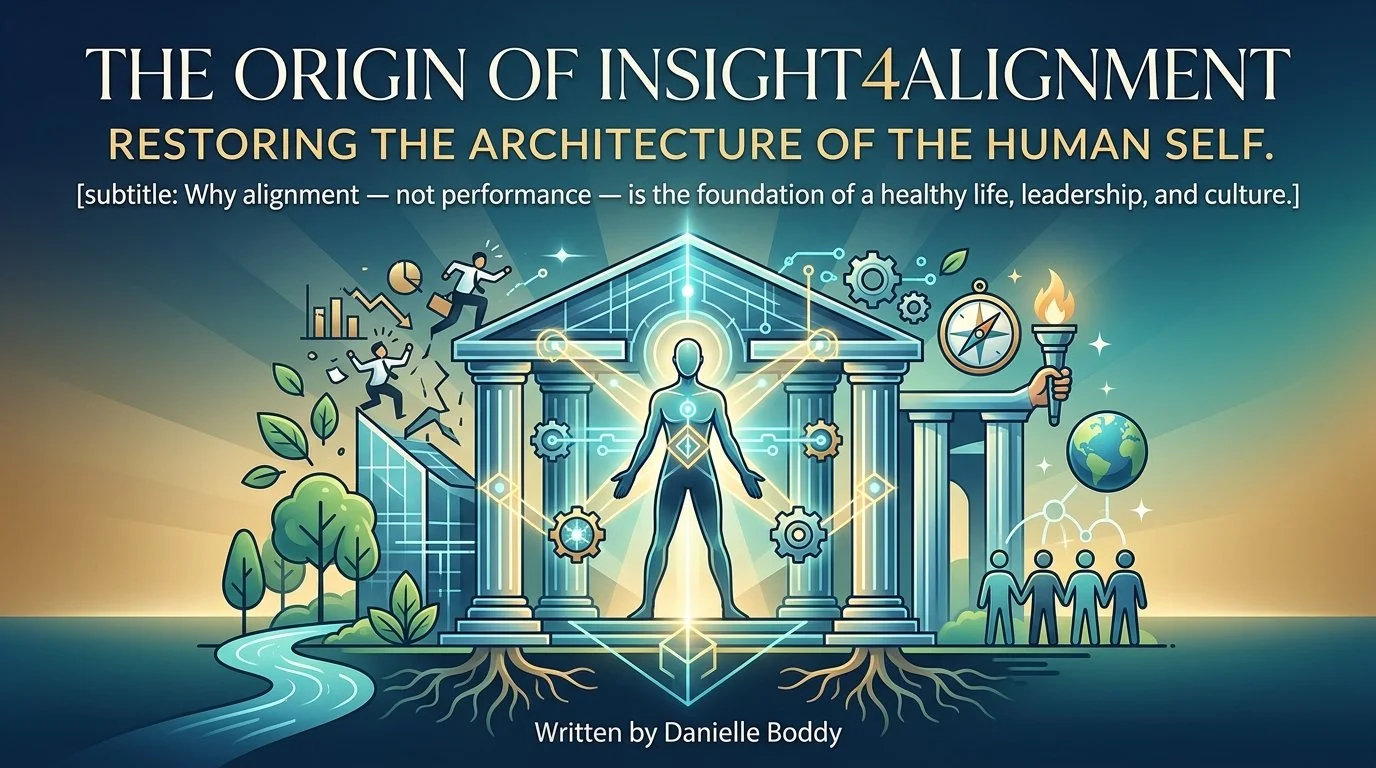
The Origin of Insight4Alignment: Restoring the Architecture of the Human Self
For much of modern life, we have been taught to measure success through performance. Productivity, achievement, and external validation have become the primary indicators of whether a life is “working.” Yet many people discover that even when they meet those expectations, something inside still feels fragmented. They are capable, responsible, and often highly accomplished — but internally divided. Their decisions feel reactive rather than grounded. Their voice feels constrained by expectations. Their sense of worth fluctuates depending on approval, productivity, or external feedback. Over time, this produces a quiet but persistent dissonance. The problem is not a lack of effort or intelligence. The problem is misalignment
Why alignment — not performance — is the foundation of a healthy life, leadership, and culture.
For much of modern life, we have been taught to measure success through performance. Productivity, achievement, and external validation have become the primary indicators of whether a life is “working.” Yet many people discover that even when they meet those expectations, something inside still feels fragmented. They are capable, responsible, and often highly accomplished — but internally divided. Their decisions feel reactive rather than grounded. Their voice feels constrained by expectations. Their sense of worth fluctuates depending on approval, productivity, or external feedback. Over time, this produces a quiet but persistent dissonance. The problem is not a lack of effort or intelligence. The problem is misalignment.
Insight4Alignment was created to address that deeper condition. Rather than focusing primarily on productivity, performance strategies, or surface-level self-improvement, the Insight4Alignment framework explores something more fundamental: the internal architecture of the human person.
Every individual operates through an internal structure that shapes perception, decision-making, relationships, and leadership. When this architecture is coherent, life begins to feel grounded and intentional. When it becomes distorted or fragmented, people often experience confusion, reactivity, or exhaustion.
Through years of reflection, study, and coaching work, five core elements consistently emerged as the structural pillars of this architecture:
Identity — who we understand ourselves to be.
Thought — the narratives and interpretations shaping perception.
Dignity — the experience of intrinsic worth and voice.
Trust — the capacity to form healthy relationships with others and the world.
Presence — the ability to show up consciously and responsibly in the moment.
When these elements align, individuals experience a sense of internal coherence. Decisions feel clearer. Leadership becomes grounded rather than performative. Relationships grow more authentic. Life begins to feel less like a performance and more like an expression of one’s deeper values. But when these structures drift out of alignment, people often attempt to compensate through effort. They work harder. They try new strategies. They pursue additional achievements. Yet the underlying architecture remains unstable.
Insight4Alignment approaches transformation differently. Instead of simply teaching techniques or motivational strategies, the work focuses on rebuilding internal architecture. Through reflection, narrative exploration, coaching frameworks, and awareness practices, individuals begin to recognize the deeper structures shaping their lives. As these structures realign, behavior naturally changes. Leadership becomes less about control and more about presence. Personal growth becomes less about proving worth and more about expressing it. Culture shifts from performance pressure toward dignity and trust.
This is why Insight4Alignment extends beyond personal coaching. The same principles that shape individuals also shape teams, organizations, families, and communities. When identity, dignity, trust, and presence become foundational cultural values, organizations move from reactive management toward conscious leadership. Teams begin to collaborate rather than compete for validation. Communities begin to heal rather than fracture under pressure.
The goal of Insight4Alignment is not perfection. The goal is coherence. It is the quiet but powerful shift from living in reaction to living in alignment.
From this foundation, a broader ecosystem of learning and practice has developed — including the Thought Lab, Practice Lab, Inner Lab, and the narrative embodiment journey of Ink & Fire. Each of these spaces explores a different dimension of alignment, helping individuals reconnect with the deeper architecture of who they are and how they live. The work continues to evolve as more people begin asking the same essential question: What happens when we stop organizing life around performance and begin organizing it around alignment?
If this question resonates with you, the Thought Lab is a place to begin exploring the ideas and frameworks behind Insight4Alignment.

Trust Culture
Trust Culture explores how leaders can build organizational environments rooted in dignity, curiosity, humility, and accountability rather than pressure and fear.
White Paper: Insight4Alignment Thought Lab
Building Leadership Environments Rooted in Dignity and Alignment
Executive Summary
Modern organizations often operate under intense performance pressure. Metrics, deadlines, and constant evaluation shape how success is measured and how individuals experience their work. While performance measurement is necessary for organizational effectiveness, it can unintentionally reshape workplace culture. When performance metrics become the primary lens for evaluating individuals, environments may begin to prioritize pressure, competition, and reaction over clarity, dignity, and intentional leadership.
The concept of Trust Culture offers an alternative framework.
Trust Culture describes leadership environments where dignity, accountability, humility, and curiosity shape how individuals interact and make decisions. Rather than relying primarily on pressure or fear-based motivation, these environments cultivate alignment between personal responsibility and organizational purpose.
This white paper explores how leaders can intentionally build cultures that support both performance and human dignity.
The Problem: Performance Without Trust
In many organizations, leaders focus heavily on outcomes without fully considering the cultural environment that produces those outcomes.
When pressure dominates the workplace environment, several patterns may emerge:
• Individuals become risk-averse
• Communication becomes guarded
• Mistakes are hidden rather than examined
• Creativity and initiative decrease
• Trust between leadership and employees erodes
In these environments, performance may continue temporarily, but the culture gradually becomes fragile. Employees may comply with expectations while disengaging emotionally from the work. Over time, organizations experience higher turnover, reduced innovation, and increasing internal friction.
This dynamic reflects a deeper structural problem: the absence of trust as a cultural foundation.
The Role of Trust in Organizational Health
Trust is not merely a positive workplace sentiment. It is a structural condition that influences how information flows, how decisions are made, and how individuals interpret leadership behavior. When trust exists within an organization, individuals are more likely to:
• Communicate openly about challenges
• Take responsible risks
• Learn from mistakes
• Collaborate across roles and departments
• Remain engaged with organizational goals
Trust does not eliminate accountability or performance expectations. Instead, it creates an environment where accountability can function effectively without generating fear or defensiveness. In this way, trust becomes a cultural infrastructure supporting both human well-being and organizational performance.
The Trust Culture Framework
Trust Culture within Insight4Alignment is built upon four foundational leadership practices.
Dignity
Leaders who cultivate trust recognize the inherent dignity of the individuals they lead. Dignity-centered leadership acknowledges that people are more than their current performance metrics. When dignity is respected, individuals are more likely to contribute authentically and take ownership of their work.
Humility
Humility allows leaders to remain open to feedback, new ideas, and the recognition that leadership itself is a learning process. Leaders who demonstrate humility create environments where employees feel safe raising concerns and contributing insight.
Brave Curiosity
Curiosity replaces defensiveness when problems arise. Rather than assigning immediate blame, leaders ask questions that help reveal the underlying dynamics of a situation. This encourages learning and continuous improvement.
Accountability
Trust does not eliminate responsibility. In fact, accountability becomes stronger in environments where trust is present. When individuals feel respected and supported, they are more likely to take responsibility for both successes and mistakes.
From Performance Culture to Alignment Culture
Trust Culture does not reject performance or productivity. Instead, it reorders the relationship between culture and outcomes. In performance-driven environments, pressure often becomes the primary driver of behavior. In trust-based environments, alignment becomes the driver. When individuals understand their role, feel respected within the culture, and trust leadership intentions, performance becomes a natural outcome of shared purpose rather than a reaction to external pressure.
Leadership as Cultural Architecture
Leaders do more than manage tasks or direct strategy. They shape the cultural environment in which people think, collaborate, and contribute. Every leadership decision communicates something about what the organization values. Over time, these signals accumulate to form the architecture of culture. Trust Culture invites leaders to recognize that culture is not accidental. It is something that can be intentionally designed and cultivated through consistent leadership behavior.
Applying the Trust Culture Model
Organizations seeking to develop a Trust Culture can begin with several foundational practices.
• Encourage open dialogue about challenges and mistakes
• Reward learning and improvement rather than only outcomes
• Model humility and curiosity at the leadership level
• Ensure accountability is balanced with dignity
These practices gradually shift the emotional climate of an organization. As trust increases, communication improves, collaboration strengthens, and individuals begin to operate with greater clarity and engagement.
Conclusion
Trust Culture represents an important shift in how leadership environments are understood. Rather than treating culture as a secondary concern behind performance metrics, this framework recognizes culture as the foundation that makes sustainable performance possible. When dignity, humility, curiosity, and accountability shape leadership behavior, organizations create environments where individuals can contribute fully without sacrificing their sense of identity or worth. In these environments, alignment between people and purpose becomes possible.
About Insight4Alignment
Insight4Alignment is a framework for rebuilding the internal and cultural structures that shape identity, thought, and decision-making. Through research, writing, programs, and leadership consulting, the work helps individuals and organizations move from reactive performance toward conscious alignment.
Work With Danielle Boddy
Danielle Boddy is the founder of Insight4Alignment and the developer of Alignment Architecture, the Alignment Method, and the Neuro-Alignment Method (NAM). Her work focuses on helping individuals and organizations rebuild the internal architecture that shapes identity, leadership, and decision-making.
Next Steps
Organizations interested in exploring the Trust Culture framework can learn more through leadership workshops, consulting engagements, and Thought Lab resources.
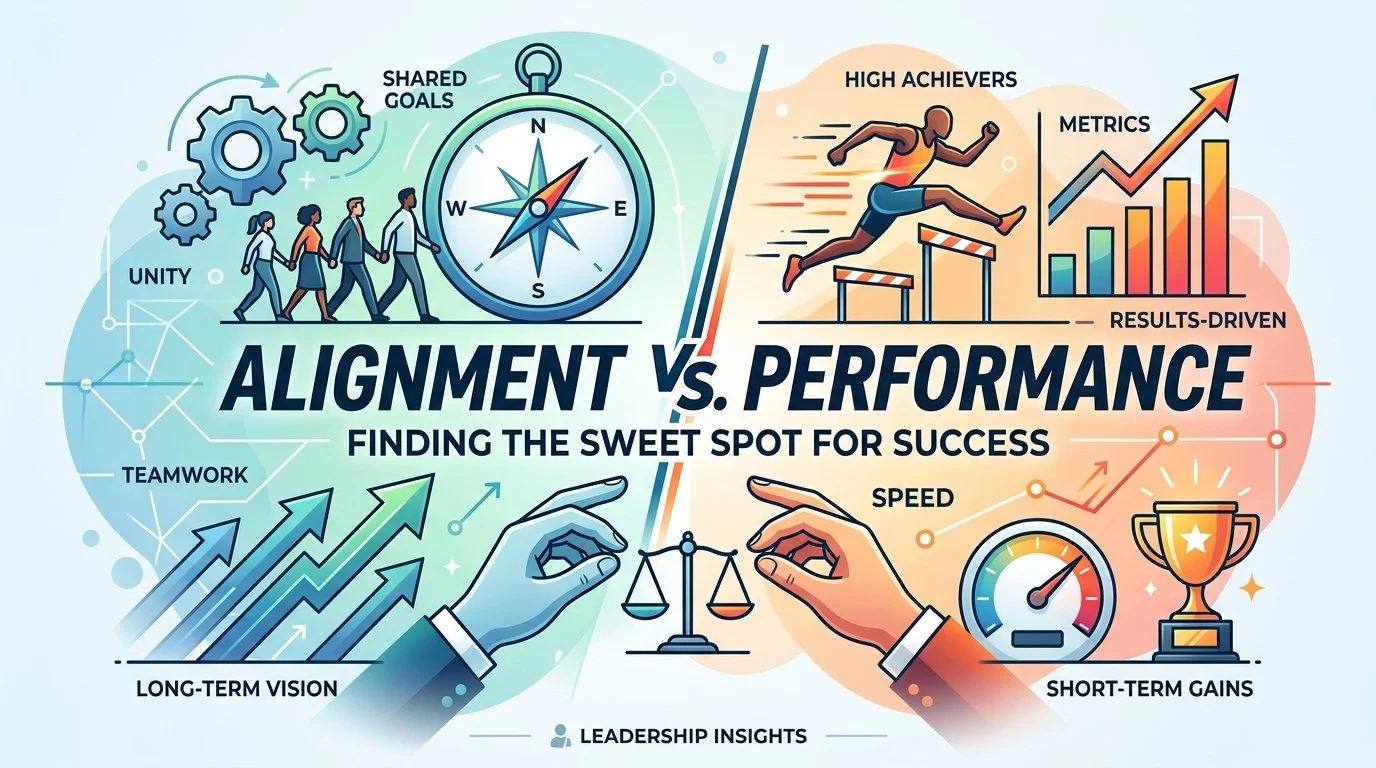
Alignment vs Performance
Many environments reward performance over alignment. This essay explores how reactive decision-making forms and how the Neuro-Alignment Method restores clarity and agency.
Why modern environments reward reaction rather than clarity
In many professional and social environments, success is measured by visible output: results, productivity, speed, and recognition. While these metrics can be useful for evaluating work, they often begin to influence something deeper—the way individuals understand themselves. Over time, people learn to organize their behavior around performance rather than alignment.
Performance asks: What will produce approval, recognition, or results?
Alignment asks: What action is consistent with identity, clarity, and integrity?
The difference between the two may appear subtle at first, but it shapes how decisions are made, how pressure is experienced, and how individuals relate to their own sense of worth.
The Culture of Reaction
Performance-based environments tend to reward speed and responsiveness. Individuals are expected to respond quickly to changing expectations, shifting goals, and external evaluation. While responsiveness can be valuable, it often encourages a pattern of reactive decision-making. Instead of pausing to consider whether an action aligns with deeper values or identity, individuals begin to prioritize immediate outcomes. Decisions become shaped by urgency, comparison, and external pressure. Over time, this pattern reinforces a subtle internal narrative: Your value depends on how well you respond to external demands.
The result is not simply increased productivity. It is the gradual replacement of internal clarity with external pressure.
Alignment Requires a Different Orientation
Alignment does not reject performance or responsibility. Work, excellence, and contribution remain important. What alignment changes is the source of action. When individuals operate from alignment, decisions begin with internal clarity rather than external pressure. Identity becomes the anchor that shapes behavior, rather than the byproduct of evaluation.
Aligned action tends to emerge from three internal conditions:
Clarity — understanding who one is becoming
Awareness — recognizing the narratives shaping decisions
Agency — choosing actions intentionally rather than reactively
When these conditions are present, performance becomes a natural outcome of alignment, rather than the primary goal.
Why Internal Narratives Matter
Much of the tension between alignment and performance occurs internally. Individuals carry narratives about responsibility, approval, success, and failure that quietly shape how they interpret situations. These narratives often form through years of cultural conditioning, professional expectations, or personal experience. Without examining these narratives, people may unknowingly continue operating from patterns that reinforce reaction rather than clarity.
This is why Insight4Alignment introduces the Neuro-Alignment Method.
The Neuro-Alignment Method helps individuals recognize internal narratives, interrupt reactive thinking patterns, and rebuild the relationship between identity, thought, and action.
Moving from Reaction to Conscious Action
Alignment begins when individuals learn to pause between stimulus and response. Instead of reacting automatically to external expectations, they begin to examine the internal narratives shaping their decisions. This shift does not reduce responsibility or performance. In many cases, it strengthens both. Individuals who operate from alignment tend to make decisions with greater consistency, integrity, and long-term clarity. The work is not about becoming less engaged with life—it is about becoming more intentional within it.
Practicing Alignment
Understanding the difference between alignment and performance is the first step. The next step is learning how to recognize and reshape the narratives that drive reactive thinking. The 21-Day Self-Talk Reset, part of the Neuro-Alignment Method, introduces practical exercises that help individuals examine internal narratives and rebuild the connection between identity, thought, and action. Through small daily practices, participants begin to replace reaction with awareness and external pressure with intentional decision-making.
Begin the Practice
If you would like to explore the practical side of this work, the 21-Day Self-Talk Reset introduces the foundations of the Neuro-Alignment Method.

When the Sacred Becomes a Metric
alignment-architecture-performance-culture.jpg
Alignment Architecture concept illustrating the shift from performance-driven identity to aligned living
In many modern environments—professional, cultural, and even personal—worth is increasingly measured through performance. Productivity dashboards, quarterly targets, social metrics, and constant evaluation quietly reshape how individuals understand themselves. Over time, these systems begin to influence something deeper than behavior: they begin to shape identity.
What begins as a method for tracking results slowly becomes a lens for measuring human value. This is the moment when the sacred becomes a metric.
The Quiet Conversion of Worth
Performance measurement is not inherently harmful. Organizations need feedback loops, and individuals benefit from clear goals. The problem emerges when measurement migrates from tools for evaluating work to standards for evaluating people. When that shift occurs, individuals begin to internalize a subtle message: Your worth must be proven.
In this environment, identity becomes tied to output, approval, and results. Effort replaces presence, and performance replaces clarity. Over time, people no longer simply do work—they begin to become their work.
The Psychological Cost of Metric-Based Identity
When identity becomes tied to performance metrics, several patterns begin to appear. Individuals may experience:
• Chronic self-evaluation
• Fear of failure or exposure
• Difficulty separating work from identity
• Exhaustion from constant proving
Rather than acting from internal clarity, decisions begin to emerge from pressure, comparison, and reaction. The result is not simply stress—it is a gradual distortion of the relationship between identity, thought, and action.
Rebuilding the Architecture of Alignment
Insight4Alignment approaches this problem from a structural perspective. Instead of focusing only on productivity or mindset, the work examines the internal architecture that shapes behavior.
Alignment emerges when four core elements are restored:
Identity — understanding who we are becoming
Thought — recognizing the narratives shaping decisions
Dignity — grounding worth beyond performance
Trust — building environments that support integrity
When these elements function together, individuals no longer operate primarily from external pressure. Decisions begin to arise from clarity, rather than reaction.
This is the foundation of Alignment Architecture.
From Performance to Presence
The solution to performance culture is not disengagement or apathy. Work and excellence still matter. What changes is the source of action. When individuals reconnect with dignity and internal clarity, effort no longer emerges from fear of failure or constant proving. Instead, it emerges from presence, responsibility, and conscious choice. The work remains meaningful—but the individual is no longer consumed by the need to justify their existence through performance.
The Beginning of the Alignment Journey
These ideas form the foundation of the Insight4Alignment framework and are explored in depth in the book:
When the Sacred Becomes a Metric
The book examines how performance culture reshapes identity and offers a framework for rebuilding the internal structures that support clarity, dignity, and aligned living. If the article resonated with you, the book expands these ideas and introduces the broader architecture behind the work.

The Architecture of Identity
Identity shapes how we interpret experience and make decisions. This essay explores identity architecture and how alignment begins with understanding who we are becoming.
Why alignment begins with understanding who we are becoming
Every decision a person makes emerges from some understanding of who they believe themselves to be. This understanding is rarely examined directly. It forms gradually through experience, relationships, cultural expectations, and the narratives individuals internalize about success, responsibility, and belonging. Over time, these influences shape what can be described as the architecture of identity.
Identity architecture refers to the internal structure that determines how individuals interpret situations, make decisions, and understand their place in the world. It is the lens through which thoughts form, behavior emerges, and meaning is assigned to experience. When this architecture is stable and intentional, individuals tend to move through life with clarity and direction. When it is fragmented or externally defined, decision-making often becomes reactive and inconsistent.
Alignment begins by understanding this structure.
Identity Is Not Static
Many people assume identity is something fixed—an unchanging description of personality or background. In reality, identity is dynamic.
It evolves through the interaction of several factors:
• Internal narratives about who we are
• Roles we occupy within families, organizations, and communities
• Cultural expectations and social feedback
• Personal values and aspirations
These elements continuously influence one another, shaping how individuals interpret their experiences. When identity is shaped primarily by external expectations, individuals may find themselves making decisions that reflect pressure rather than clarity. When identity is shaped intentionally, individuals begin making decisions from a clearer sense of who they are becoming.
The Relationship Between Identity and Thought
Identity does not operate independently from thought. The narratives individuals carry about themselves influence the way they interpret events, challenges, and opportunities. For example, a person who internally identifies as someone who must constantly prove their value may interpret neutral situations as evaluations of their worth. This can lead to patterns of overworking, perfectionism, or fear of failure. Another individual whose identity is grounded in dignity and purpose may interpret the same situation as an opportunity to contribute or learn. In both cases, the external situation may be identical. What differs is the identity architecture through which the situation is interpreted.
Rebuilding Identity Architecture
When individuals begin exploring alignment, they often focus first on behavior or productivity. While these areas matter, they rarely address the deeper structures that shape action. Insight4Alignment approaches this work differently. Instead of beginning with performance or output, the work begins by examining the internal architecture shaping decisions.
This process involves:
• Recognizing the narratives that influence identity
• Examining the roles individuals have internalized
• Clarifying personal values and direction
• Reconnecting identity with dignity rather than performance
When individuals rebuild identity architecture intentionally, behavior begins to change naturally. Actions become less reactive and more consistent with long-term direction.
Identity and Alignment
Alignment emerges when identity, thought, and action move in the same direction.
When identity is externally defined or fragmented, individuals may feel constant tension between what they do and who they feel they are supposed to be. When identity becomes intentional and grounded, decisions begin to feel less conflicted. Effort becomes more focused, and the relationship between responsibility and meaning becomes clearer. In this way, identity architecture forms the starting point of alignment.
Practicing Identity Alignment
Understanding identity conceptually is valuable, but meaningful change requires reflection and practice.
The 30-Day Identity Alignment program introduces structured exercises designed to help individuals examine the narratives shaping identity and begin rebuilding their internal architecture intentionally. Through guided reflection and practical exercises, participants learn to reconnect their decisions and actions with the person they are becoming.
Begin the Practice
If you would like to explore this work more deeply, the 30-Day Identity Alignment program offers a structured pathway for examining and rebuilding identity architecture.
Breath as Evidence: Dignity Before Performance
Breath is the simplest evidence of belonging. This essay explores how restoring dignity before performance helps rebuild alignment in identity, thought, and action.
Restoring dignity before performance
Many people carry a quiet assumption about their worth: it must be earned. This assumption often forms gradually through cultural expectations, educational environments, professional systems, and personal experiences. Individuals learn—sometimes subtly and sometimes explicitly—that value must be proven through performance, productivity, or approval.
Over time, this belief becomes internalized. Instead of experiencing life as something to inhabit, individuals begin to experience life as something to justify. The result is a constant pressure to demonstrate competence, usefulness, or success in order to feel legitimate.
Insight4Alignment approaches this problem from a different starting point. Before performance, before achievement, before recognition, there is something far more fundamental. There is breath.
Breath as the First Evidence of Worth
Breath is the most basic sign of life. It requires no qualification, no certification, and no external validation. If a person is breathing, they are alive. If they are alive, their existence already carries inherent significance. This simple recognition challenges one of the most deeply embedded narratives in performance culture: that worth must be proven. Breath offers a different perspective. It reminds us that life itself precedes achievement. In this sense, breath becomes evidence—not of accomplishment, but of belonging.
When Worth Becomes Conditional
Performance-based environments often transform value into something conditional. Worth becomes tied to:
• Productivity
• Success
• Approval
• Comparison
• Visible outcomes
Under these conditions, individuals may begin to feel that rest, reflection, or uncertainty represent failure rather than natural parts of being human. The more someone internalizes this belief, the more difficult it becomes to separate identity from performance. Eventually, people may feel that they are only as valuable as their most recent success. This is one of the quiet costs of performance culture.
Restoring the Foundation of Dignity
Dignity is not something that emerges after success. It is the foundation from which healthy action becomes possible.
When individuals reconnect with dignity, effort begins to change in quality. Instead of acting primarily from fear of failure or the need for approval, individuals begin acting from a sense of responsibility, contribution, and clarity. Work still matters. Excellence still matters. What changes is the source of motivation. Actions begin to emerge from presence rather than pressure. This shift allows individuals to participate fully in their work and relationships without constantly measuring their value against external standards.
The Practice of Breath as Evidence
Understanding dignity intellectually is one step. Learning to experience it is another.
The Breath as Evidence practice invites individuals to pause long enough to recognize the simple reality that life itself is not something that must be justified. Through reflection, awareness exercises, and small daily practices, participants learn to interrupt the internal narrative that says worth must always be proven. The work is not about rejecting effort or ambition. Instead, it helps individuals rebuild the internal foundation from which effort can emerge in a healthier way. From that place, action becomes more intentional, relationships become more grounded, and the pressure to constantly prove one's existence begins to soften.
Living from Dignity Rather Than Proof
When individuals begin operating from dignity rather than proof, a quiet but profound shift occurs. They still contribute, still pursue meaningful goals, and still engage deeply with life. But the relationship between identity and performance changes. Work becomes an expression of life rather than a justification for it.
This is the beginning of alignment.
Begin the Practice
If you would like to explore this work in a structured way, the 21-Day Agency Restoration program introduces the core practices behind Breath as Evidence. Through guided exercises and reflection, participants begin rebuilding their relationship with dignity, agency, and intentional living.
The Neuro-Alignment Method
The Neuro-Alignment Method helps individuals recognize internal narratives, interrupt reactive thinking patterns, and rebuild the relationship between identity, thought, and action.
Retraining the narratives that shape how we think and decide
Many people attempt to change their lives by focusing on behavior alone. They set new goals, adopt new habits, and push themselves toward greater productivity or discipline. While these efforts can produce short-term results, they often fail to address the deeper patterns shaping how decisions are made. Behind every action is a thought. Behind every thought is a narrative. And behind many of those narratives is an identity that was formed long before the current moment.
The Neuro-Alignment Method begins by examining these internal structures. Rather than focusing only on external behavior, the method helps individuals recognize the narratives and thought patterns that quietly shape how they interpret the world.
The Role of Internal Narratives
Human beings continuously interpret experience through internal stories. These narratives help us make sense of events, relationships, and expectations. Over time, they become automatic frameworks through which we evaluate ourselves and others. Some of these narratives support clarity and agency. Others reinforce pressure, fear, or the belief that worth must constantly be proven. Because these narratives operate largely beneath conscious awareness, individuals may continue repeating patterns long after the original conditions that created them have changed.
The Neuro-Alignment Method introduces practices that bring these narratives into awareness so they can be examined intentionally.
From Reaction to Awareness
One of the most important shifts in alignment occurs when individuals begin to recognize the space between stimulus and response. Without awareness, external pressures often trigger automatic reactions. People respond quickly to expectations, criticism, comparison, or uncertainty without examining the thoughts driving those reactions. When awareness increases, that automatic loop begins to loosen. Individuals start noticing the narratives that influence their interpretation of situations. Instead of reacting immediately, they gain the ability to pause, reflect, and choose a response more intentionally. This shift transforms decision-making. Actions begin to emerge from conscious reflection rather than conditioned reaction.
Rebuilding the Relationship Between Identity, Thought, and Action
The Neuro-Alignment Method works by reconnecting three elements that often become fragmented in performance-driven environments.
Identity
Thought
Action
When these elements drift apart, individuals may find themselves acting in ways that feel disconnected from who they believe themselves to be. Through structured reflection and guided practices, the method helps individuals bring these elements back into alignment. As this relationship strengthens, decisions become more consistent, internal conflict begins to decrease, and individuals gain a greater sense of agency over their choices.
The Practice of Self-Talk Awareness
One of the most accessible ways to begin this work is by examining self-talk. Self-talk represents the running dialogue individuals maintain with themselves throughout the day. It influences interpretation, emotional response, and behavioral choices. Because this dialogue often operates automatically, many people are unaware of how strongly it shapes their experience.
The Neuro-Alignment Method introduces practices that help individuals notice, question, and gradually reshape these internal conversations. Through consistent awareness, reactive patterns begin to weaken and intentional thinking becomes more natural.
The 21-Day Self-Talk Reset
The 21-Day Self-Talk Reset introduces the core practices of the Neuro-Alignment Method. Over three weeks, participants engage in small daily exercises designed to help them recognize internal narratives, interrupt reactive patterns, and rebuild the relationship between identity, thought, and action. The goal is not perfection or constant self-monitoring. Instead, the program helps individuals develop the awareness necessary to respond to life with greater clarity and intention. From that foundation, deeper alignment becomes possible.
Begin the Practice
If you would like to explore the Neuro-Alignment Method through guided exercises, the 21-Day Self-Talk Reset offers a structured introduction to the practices described here. Through daily reflection and awareness exercises, participants begin retraining the internal narratives that shape how they think, decide, and act.