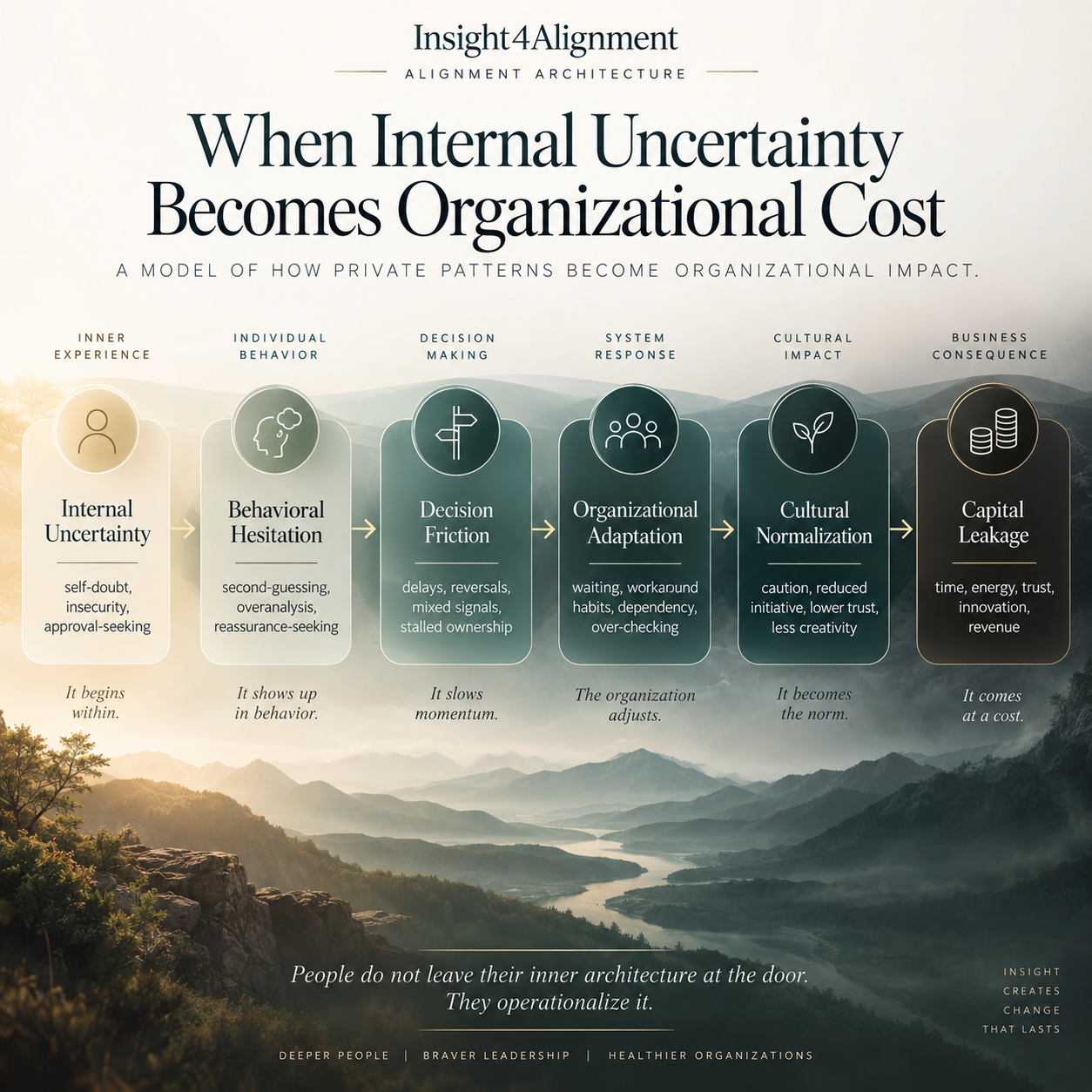
The hidden organizational cost of second-guessing, approval-seeking and the need to feel certain
How self-doubt, approval-seeking, overthinking and fear of criticism can move beyond the individual to shape leadership decisions, team behavior and organizational culture.
There is a persistent fiction in professional life that we somehow become psychologically neutral when we arrive at work. We don’t. We bring our relationship with criticism, uncertainty, approval, rejection, authority, conflict, boundaries and self-trust into every room we enter. We bring it into the way we read an email, interpret another person’s tone, respond when somebody disagrees, decide whether to delegate, tolerate an imperfect outcome, or change direction after receiving criticism.
Most of this doesn’t announce itself as “inner work.” It looks like management.
That is precisely why it matters. A leader’s insecurity does not have to appear as visible insecurity. It can appear as another meeting. Another revision. Another person consulted. Another exception made because somebody is unhappy. Another decision reopened because one stakeholder questioned it. Another round of research when the organization already has enough information to proceed.
Eventually, what began as an internal experience can become an operating system.
When thoughtful leadership becomes reassurance-seeking
There is nothing inherently wrong with reconsidering a decision. Good leaders seek evidence, listen carefully and change direction when new information warrants it. The question is what the additional thinking is accomplishing.
Sometimes another conversation produces insight. Sometimes it simply reduces anxiety for twenty minutes.
That distinction is easy to miss because approval-seeking can wear the clothing of admirable leadership. It can look like collaboration. Conflict avoidance can look like kindness. Self-doubt can look like humility. Accommodation can look like flexibility. Reassurance-seeking can look like consultation.
But they are not the same things.
The underlying question quietly changes from What does this situation require? to Can I make this decision without anyone being disappointed in me?
That changes the organizational equation. The leader is no longer solving only the strategic problem. They are also trying to solve an internal problem: How do I make uncertainty, criticism or disapproval go away? And an organization can spend an extraordinary amount of time trying to solve that second problem.
McKinsey’s research illustrates just how economically significant ineffective decision processes can become. In its survey of executives and managers, respondents reported spending an average of 37% of their time making decisions, while more than half of that decision-making time was considered ineffective. McKinsey estimated that, for a typical Fortune 500 company, that could represent more than 530,000 manager-days and roughly US$250 million in labour costs annually.
The important issue here is not simply speed. It is what the organization is doing with all that cognitive effort.
The organization begins adapting to the person
This is where Alignment Architecture becomes particularly useful. Consider this progression:
Internal uncertainty → behavioral hesitation → decision friction → organizational adaptation → cultural normalization → capital leakage.
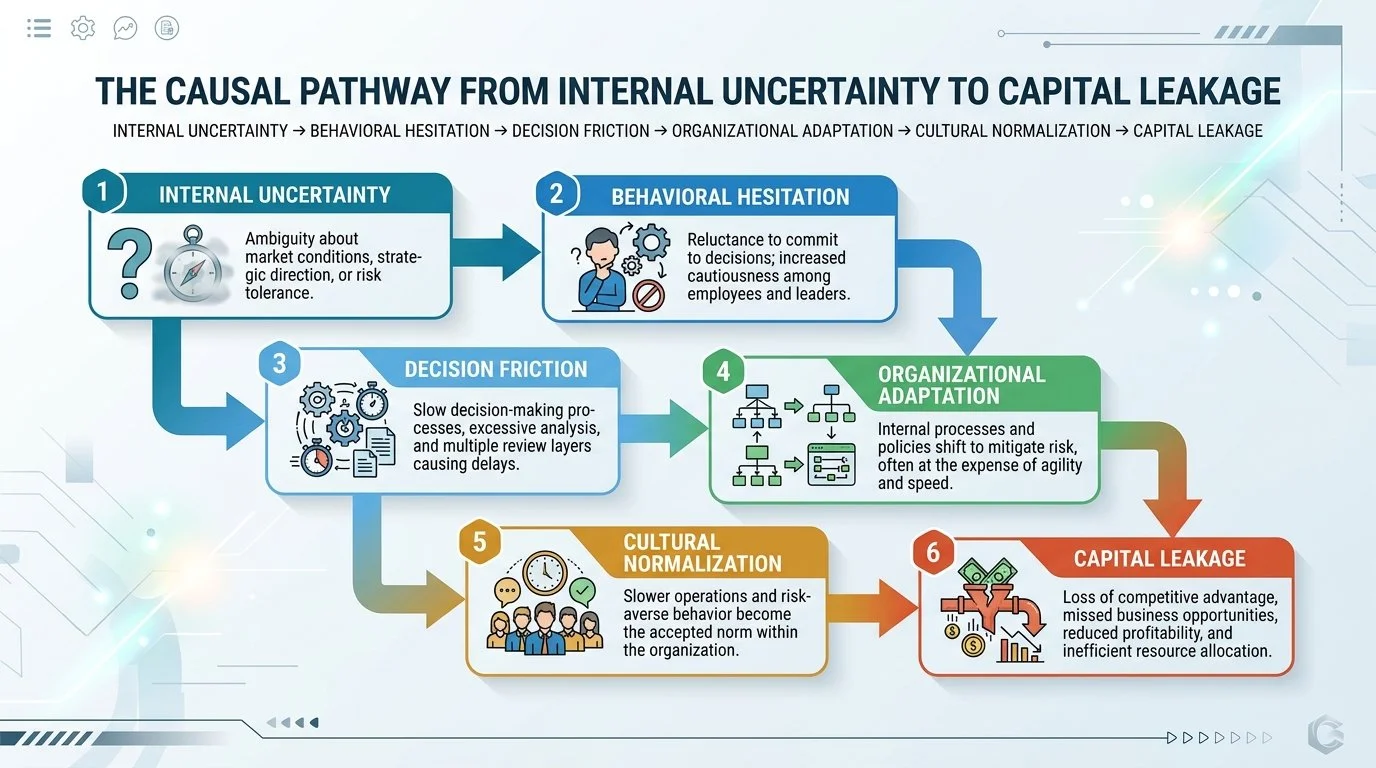
Insight4Alignment Graph 1
At first, the uncertainty belongs to one person. Then other people begin having to accommodate it.
If decisions are frequently reopened, employees learn not to move too far ahead. If the leader repeatedly asks for reassurance, people learn how to provide reassurance. If disagreement routinely produces defensiveness, people become careful about how much truth they bring into the room. If every meaningful decision ultimately travels back to the founder, people stop fully inhabiting the authority they were supposedly given.
Nothing in the employee handbook needs to change. The organization learns anyway. And over time, those adaptations become culture.
This is not speculative territory in the broad sense. A 2024 meta-analysis involving 109 independent samples and more than 32,000 participants found meaningful relationships between attachment patterns and workplace outcomes including job performance, burnout, job stress, engagement, trust in supervisors and leader-member relationships.
That does not mean executives should be diagnosed from across the boardroom table. It means the assumption that our relational patterns somehow disappear when the professional relationship is difficult to sustain. Human beings remain human at work.
You can hire ten brains and still operate through one
One of the more expensive consequences is what happens to distributed intelligence. An uncertain leader may believe they are protecting quality by checking everything. In reality, the organization can gradually learn that judgment belongs at the top.
People begin waiting. They stop taking risks they once would have taken. They bring decisions upward that they could reasonably make themselves. Creative work becomes provisional because nobody knows whether today’s direction will still be tomorrow’s direction. Eventually, the leader who thinks about everything can unintentionally create an organization in which everyone else thinks less.
Research on empowering leadership points in the opposite direction. A meta-analysis of 105 samples found empowering leadership positively associated with performance, organizational citizenship behaviour and creativity at both individual and team levels, with trust and psychological empowerment helping explain those relationships.
There is an economic idea inside that finding that deserves more attention: Unused judgment is unused capital.
An organization may be paying for the intelligence, creativity and experience of twenty people while its decision architecture continually reduces them to executors waiting for one person’s certainty. That is not simply a morale problem. It is capital leakage.
The hidden cost is not only indecision
The same principle applies beyond overthinking. Impatience enters communication. Perfectionism enters expectations. Fear of rejection enters boundaries. Suspicion enters interpretation. Harsh self-criticism can become harsh organizational criticism. A person who experiences disagreement as personal rejection may unintentionally build a culture in which disagreement feels dangerous.
This is why organizational problems can be misdiagnosed.
What appears to be an accountability problem may partly be a trust problem.
What appears to be a communication problem may partly be a tolerance-for-disagreement problem.
What appears to be a delegation problem may actually be a self-trust problem at the top.
What appears to be excessive consultation may be fear of owning an unpopular choice.
The organizational symptom is real. But sometimes the architecture producing it sits several layers deeper.
The doorway is not “be more decisive”
That advice is too shallow.
A person can force themselves to make faster decisions and remain just as internally governed by approval, fear and insecurity.
The better question is: What am I asking this organization to help me regulate?
Do I need my team to agree with me before I can trust myself?
Do I need another person’s comfort before I can hold a boundary?
Do I need certainty before I will accept responsibility?
Do people have to manage my reaction before they can tell me the truth?
That is where Human Readiness enters the conversation. Readiness is not absolute confidence. It is not the elimination of doubt. It is sufficient internal capacity to remain responsible while uncertainty, disagreement and imperfect information are still present.
Because people do not leave their inner architecture at the office door. They operationalize it. And when a person has enough authority, what they have not learned to hold within themselves can eventually become something the entire organization has to carry.