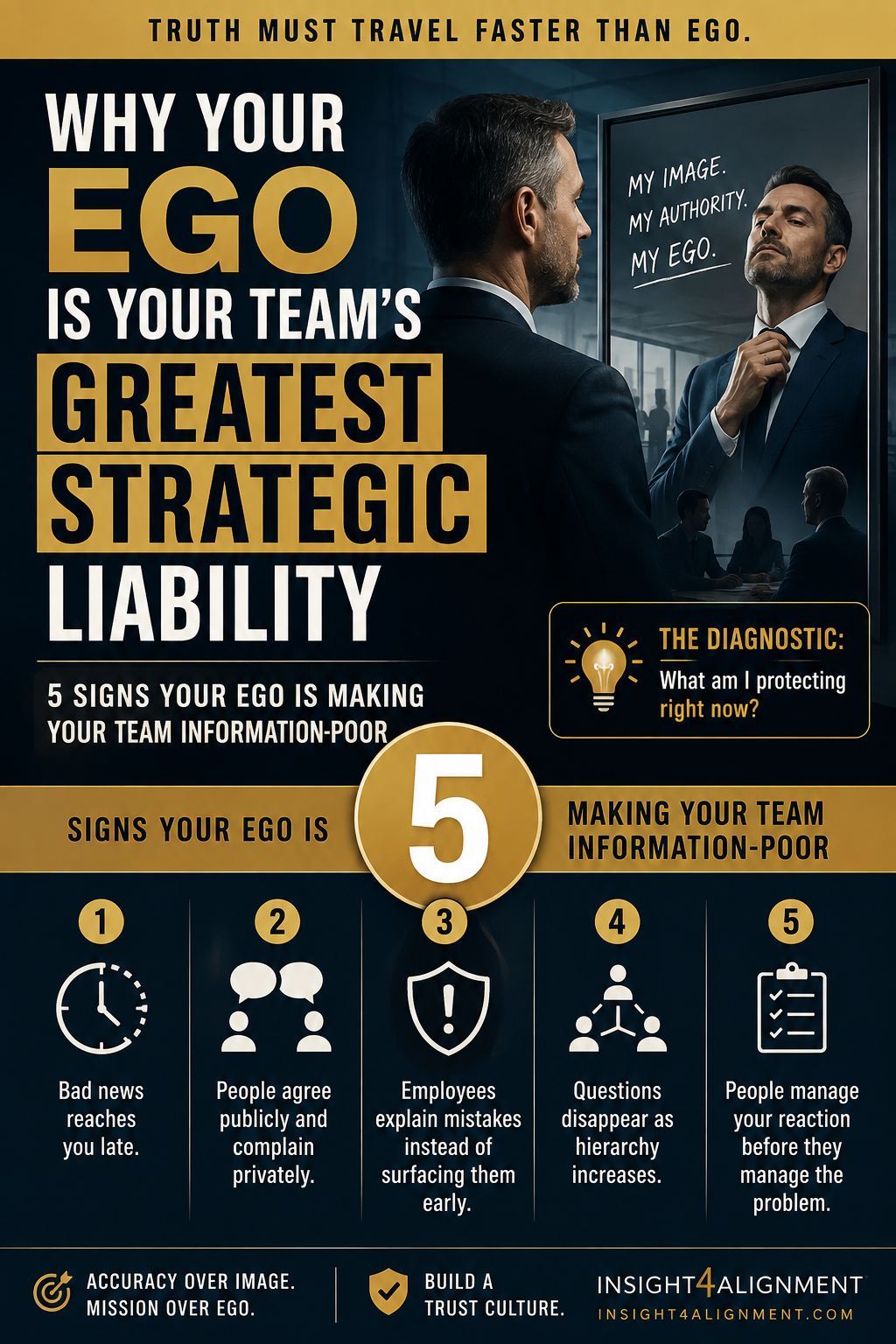
Why Your Ego Is Your Team’s Greatest Strategic Liability
Discover how unmanaged ego becomes a strategic leadership liability. This article reveals 5 signs your team is becoming information-poor and shows how humility, psychological safety, and grounded leadership build trust, accountability, and stronger performance.
5 Insights to Build a "Trust Culture"
1. Introduction: The High Cost of Being "Right"
In high-stakes leadership, we often mistake defensiveness for "standing our ground" or "maintaining high standards." In reality, professional defensiveness is not a personality trait; it is a strategic liability that induces "Information Poverty." When a leader’s primary focus shifts toward protecting their image, they inadvertently signal that the truth is too "relationally expensive" for their team to share.
To build a high-performing organization, leaders must move from Automatic Protection—the biological default of reacting to perceived threats—to Humble Presence. This presence is the secure middle ground between self-erasure and arrogance. It allows you to enter the "Grounded Leadership" quadrant: possessing high confidence in your abilities without the desperate need for superiority.
2. The "Information Poverty" Trap
Information Poverty is a high-risk state where critical facts, risks, and errors remain hidden because the culture makes them too costly to surface. If your team has to navigate your ego to tell you the truth, they will eventually stop trying.
"In high-stakes professional environments, unmanaged defensiveness is far more than a personality friction; it is a strategic liability that generates 'Information Poverty.'"
As a strategist, your goal is to ensure that truth travels faster than ego-protection. When leaders prioritize their professional image over the acquisition of truth, they effectively silence the team’s collective intelligence. If truth is expensive, your organization is poor.
3. The 10 Hidden Assets We Are Actually Protecting
Defensiveness is rarely about the project; it is a survival mechanism for specific "vulnerability targets." When we decouple our behavior from our identity, we reduce the "relational expense" of admitting errors. This isn't a moral failing; it’s mechanics. We become defensive when we perceive a threat to our:
Competence
Intelligence
Authority
Reputation
Status
Belonging
Control
Likability
Certainty
Expertise
By acknowledging these as assets we are biologically wired to protect, we can lower the cost of resolution. Admitting a mistake is no longer a threat to your worth; it is simply a move toward better data.
4. Decoding the Ego Protection Loop
The Ego Protection Loop follows a predictable pipeline: Trigger → Interpretation → Protection → Behavior → Team Impact.
The critical pivot point is Interpretation. When a challenge is interpreted as a threat to your worth, your brain shifts from collaboration to protection. Some might argue, "I don't have time to ask everyone for their opinion." But humility isn’t about consensus; it’s about knowing when a different perspective improves the quality of your decision. It allows you to address incompetence without unnecessarily diminishing the person.
Triggering Event: An employee questions a decision.
Defensive Script (Ego): "They don't respect my authority or my role."
Humble Script (Curiosity): "There may be something here I haven't considered."
Resulting Team Impact: Trust grows; truth moves upward.
Event: A colleague corrects a public error.
Defensive Script (Ego): "They are trying to make me look incompetent."
Humble Script (Curiosity): "Accuracy is more important than my image."
Resulting Team Impact: Problems are surfaced while they are small and fixable.
Event: A plan is challenged in a meeting.
Defensive Script (Ego): "They are undermining the project's success."
Humble Script (Curiosity): "What am I missing that they are seeing?"
Resulting Team Impact: Risks are vetted; decisions are reality-based.
5. The Cultural Audit: 6 Signs Your Protocol is Working
As a team moves toward a "Trust Culture," specific indicators emerge. These signs show that truth, dignity, and learning now outweigh ego preservation:
Earlier Problem Reporting: Risks and errors are surfaced while manageable, rather than being hidden until they escalate.
Accuracy Over Image: A collective prioritization of finding the "right answer" over the performance of "being right."
Reduction in "Underground" Gossip: Side-channel complaining and "parking lot meetings" are replaced by direct, humble communication.
Increased Questions: Team members prioritize active information-seeking over maintaining a facade of false certainty.
Shared Credit: Recognition moves naturally toward contributors rather than being hoarded at the top of the hierarchy.
Information Flow: Critical data moves upward without being filtered by the fear of a leader’s reaction.
6. The "Balanced Pause": Practical Tools for Grounded Leadership
To shift from defense to curiosity, you must master the Notice-Name-Reconsider-Choose model. This creates the "Balanced Pause":
Notice: Identify the physical sensation of being triggered.
Name: Explicitly identify which asset (e.g., status, expertise) you feel is under threat.
Reconsider: Question the intent—is this a threat to your worth or a contribution to the mission?
Choose: Select a response that prioritizes accuracy over protection.
Practice these "Humble Responses" to keep the flow of reality intact:
"Walk me through what you're seeing."
"What concerns you most?"
"Is there information I’m missing?"
"What part of the plan feels weakest to you?"
"What would you recommend we look at?"
The Strategist’s Insight: Humility does not dilute your decision-making authority; it improves the quality of the information you possess before you exercise it.
7. Conclusion: The Diagnostic Question
A true trust culture is not the absence of ego-driven triggers, but the development of the awareness necessary to choose a different response. Awareness is the prerequisite for professional choice.
As you navigate your next 30 days of leadership, interrupt the Ego Protection Loop with one diagnostic question: "What am I protecting right now?"
When you stop protecting your image, you finally become free to protect the mission.
Watch more: https://youtu.be/ChbM406083o
Join my Skool Community today: https://www.skool.com/alignspace-2699/about
Follow me on Facebook at: www.facebook.com/DanniTheInsightCoach/
ENTER THE DOORWAY INTO I4A: https://claude.ai/public/artifacts/888c15be-909d-4e92-a00a-72f5dbab3f6d
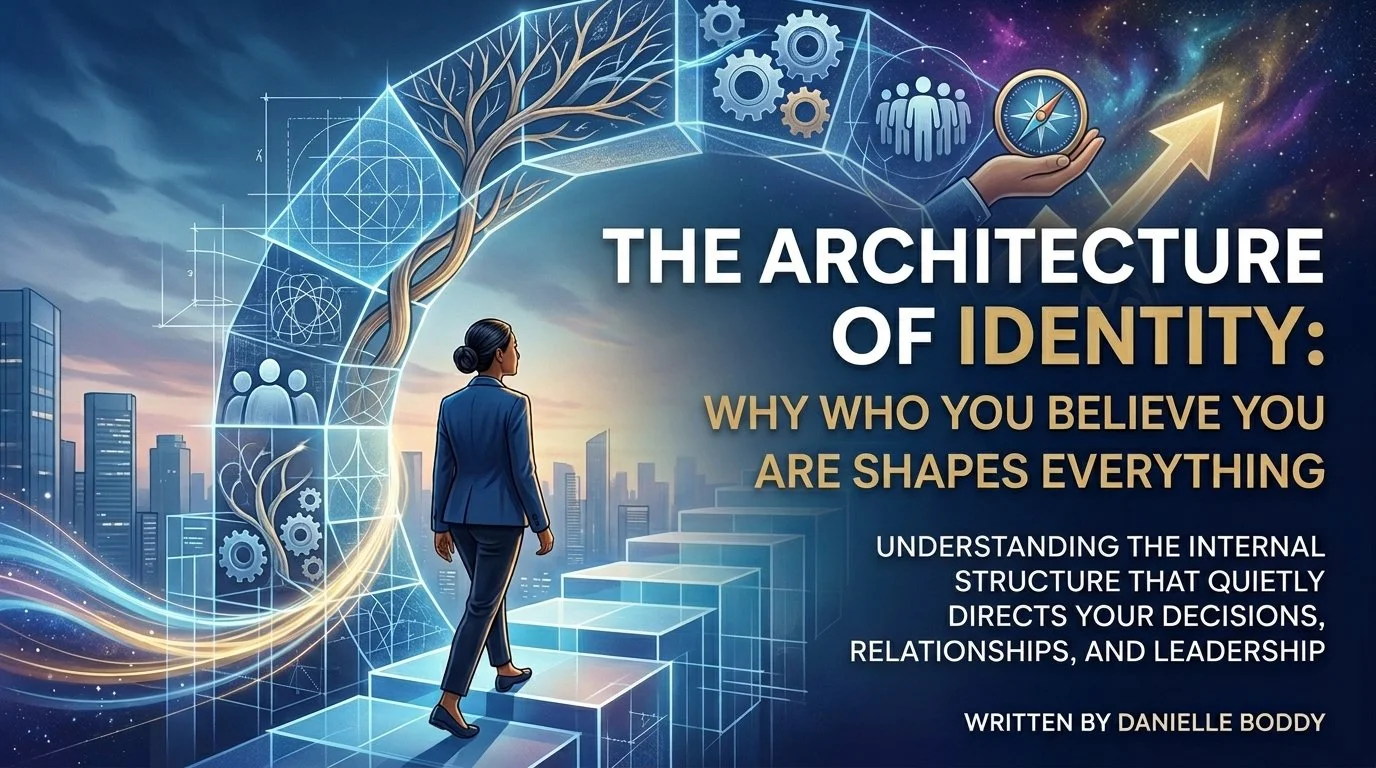
The Architecture of Identity: Why Who You Believe You Are Shapes Everything
Explore how identity functions as an internal architecture shaping decisions, relationships, and leadership, and how rebuilding identity clarity restores alignment.
Understanding the internal structure that quietly directs your decisions, relationships, and leadership.
Most people think of identity as a label, a job title, a role in a family, a set of personality traits, or a list of experiences. These descriptions may reflect aspects of a person’s life, but they do not fully explain the deeper structure that shapes how a person moves through the world.
Identity is not simply something we describe. It is something we inhabit. The beliefs we hold about who we are quietly shape the way we interpret events, make decisions, and respond to challenges. Identity influences the boundaries we set, the opportunities we pursue, and the voices we listen to when navigating uncertainty. Because of this, identity functions less like a label and more like an internal architecture. It is the framework through which life is experienced.
When identity is grounded and coherent, people tend to experience a sense of stability. Their decisions reflect their values. Their actions align with their deeper convictions. They can navigate pressure without losing their voice. But when identity becomes fragmented, life begins to feel unstable. A person may move between different expectations depending on the environment they are in. At work, they become one version of themselves. At home, another. In moments of stress, they may default to patterns that no longer reflect who they want to be.
Over time, this creates a quiet tension. Many people describe feeling as though they are performing versions of themselves rather than living from a clear center. This fragmentation rarely happens suddenly. More often, it develops gradually through a lifetime of external influence. Cultural expectations, institutional structures, family narratives, and social pressures all shape the way individuals learn to see themselves.
In performance-driven environments, identity can slowly become tied to achievement. A person begins to understand themselves primarily through what they accomplish, how they are perceived, or whether they meet the expectations placed upon them. When that happens, identity becomes unstable. If worth is tied to performance, then moments of difficulty or criticism can begin to feel like threats to the self rather than growth opportunities. People may become highly productive but internally anxious, constantly trying to maintain the image they believe others expect.
The Insight4Alignment framework approaches identity differently. Rather than viewing identity as a static label, it recognizes identity as part of a larger internal structure that includes thought, dignity, trust, and presence. These elements work together to form the architecture through which individuals understand themselves and relate to the world. Identity sits at the center of this structure. It answers the fundamental question: Who am I, and from what place do I live and lead?
When identity becomes grounded in dignity rather than performance, people experience a different kind of stability. Their worth no longer fluctuates based on approval or outcomes. Instead, they begin to act from a deeper awareness of their values and voice. This does not eliminate challenges, but it changes how challenges are interpreted. Instead of seeing difficulty as evidence of personal inadequacy, aligned individuals begin to see challenges as opportunities to refine clarity and strengthen character. In this way, identity becomes less about defending an image and more about expressing an authentic center.
The work of rebuilding identity architecture requires reflection. People must learn to examine the narratives that have shaped their understanding of themselves and decide which ones are worth carrying forward. This process is not about constructing a new persona. It is about rediscovering the deeper architecture that has often been buried beneath years of expectation and adaptation.
When individuals reconnect with that architecture, the effects ripple outward. Thought patterns become more intentional. Dignity becomes grounded rather than conditional. Trust becomes relational rather than transactional. Presence becomes steady rather than reactive. Identity begins to function not as a mask but as a foundation. And from that foundation, a person can begin to live, lead, and contribute with clarity.
This is the beginning of alignment. When identity becomes aligned with dignity and conscious awareness, life no longer revolves around proving worth. It becomes an expression of who you are becoming.