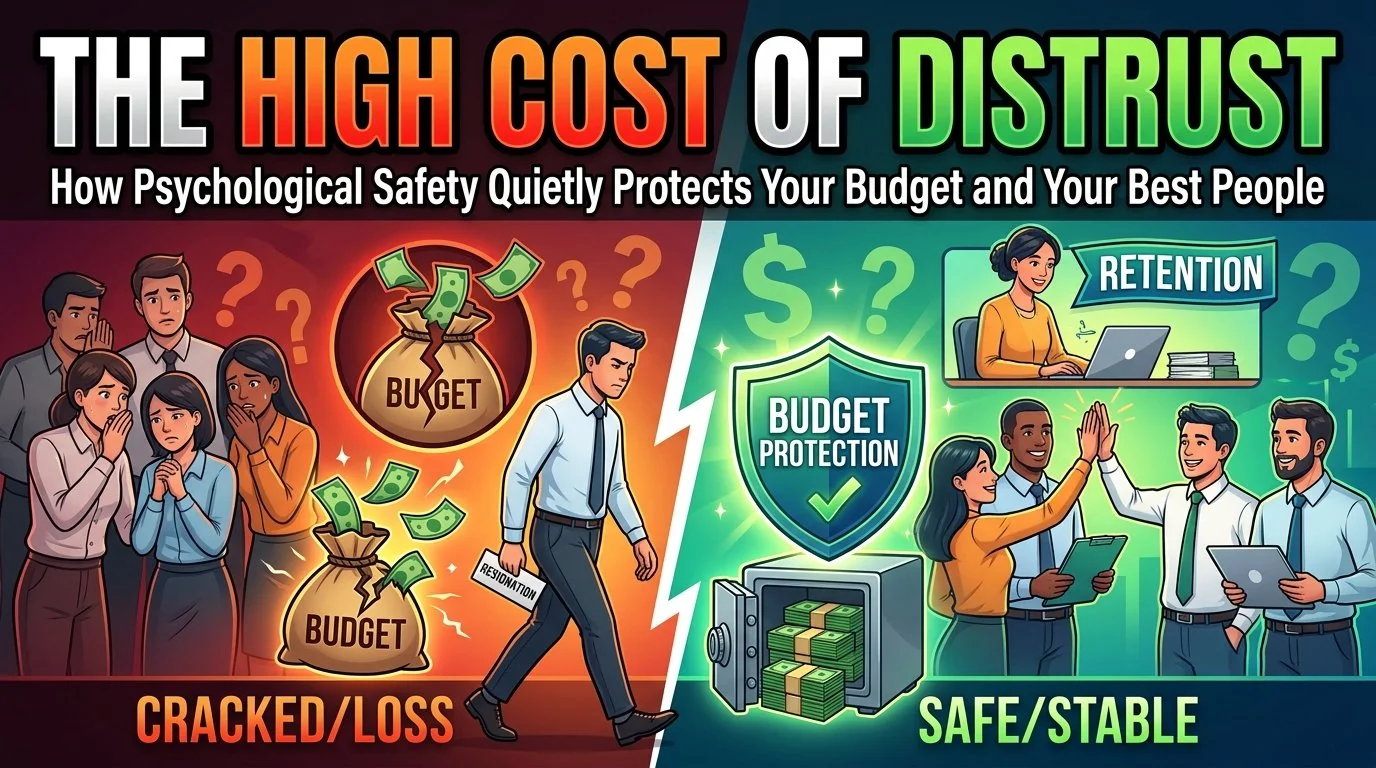
The High Cost of Distrust
Distrust and fear-based leadership can quietly damage workplace culture, reduce psychological safety, increase employee turnover, and create costly business consequences. When ego-driven management replaces trust, organizations risk losing talent, productivity, innovation, and long-term stability. Psychological safety is not only a leadership value; it is a strategic responsibility that protects people, performance, and organizational sustainability.
How Psychological Safety Quietly Protects Your Budget and Your Best People
Organizations love to measure what is visible: revenue, expenses, headcount, performance metrics, quarterly targets. However, some of the most expensive forces inside a company are not immediately visible. Distrust is one of them. Psychological safety is another. One quietly drains your budget. The other quietly protects it. Yet, many leaders underestimate both.
The Hidden Ledger: What Distrust Really Costs
Distrust rarely appears as a formal line item on a financial statement. It shows up elsewhere. It shows up in delayed decisions. In rework and duplication. In avoidance, silence, and second-guessing. In turnover,disengagement,burnout, and emotional exhaustion. In innovation paralysis. In compliance instead of contribution.
These are not “soft” issues. They are operational inefficiencies with measurable financial consequences.
A low-trust culture does not simply affect morale. It slows the system. It increases friction. It causes people to withhold ideas, protect themselves, avoid risk, and spend energy managing the room instead of moving the work forward.
That kind of culture is expensive.
Turnover: The Most Visible Cost of Distrust
Turnover is one of the clearest ways distrust becomes measurable. Replacing an employee can cost significantly more than the salary attached to the role, especially once recruitment, onboarding, lost productivity, training time, and knowledge transfer are included. For specialized, senior, or leadership roles, the cost rises even higher.
Consider a 50-person team that loses five employees in one year due to distrust, burnout, or psychological unsafety. If each departure costs the organization an estimated $120,000, the annual loss becomes: 5 departures × $120,000 = $600,000 That is $600,000 in one year, from one team, and that number does not include the deeper cultural ripple effect:
Lost institutional knowledge.
Disrupted team cohesion.
Onboarding drag.
Declining morale among those who remain.
Cultural instability.
A quieter workplace where people begin wondering whether they should leave too.
Turnover is rarely random. Often, it is a referendum on trust.
The Fear Tax: Productivity Loss in Low-Trust Cultures
When trust is low, people self-protect. They become careful. Guarded. Politically aware. Quiet in the meetings where their voice is needed most.
Self-protection is expensive because it diverts energy away from contribution. Instead of asking the hard question, people stay silent. Instead of naming the problem early, they wait until it becomes urgent. Instead of taking ownership, they seek permission. Instead of innovating, they avoid being wrong. This is the fear tax. It is the hidden cost an organization pays when employees spend their best cognitive and emotional energy managing risk instead of creating value.
If a 20-person team represents $2.5 million in annual payroll, even a 10% productivity loss caused by fear, friction, avoidance, or distrust equals: $250,000 lost annually. From one team. Multiply that across departments, and distrust becomes systemic.
Innovation Loss: The Most Expensive Cost of All
Innovation is not only a technical process. It is a psychological one. When psychological safety is low, people do not offer bold ideas in rooms where mistakes are punished. They do not challenge flawed assumptions in cultures where disagreement is treated as disloyalty. They do not take initiative when every move is monitored, criticized, or second-guessed.
When psychological safety is low, people withhold the very insight the organization needs. There is a creativity paralysis. In fact, people stop proposing new ideas. They stop challenging weak strategy. They stop experimenting. They stop telling the truth early enough. By the time leadership finally hears the truth, the cost has already grown. This is because innovation is not just a competitive advantage. It is a survival strategy. Distrust suffocates it.
Micromanagement: The Leadership Style That Bleeds Money
Micromanagement is not just a leadership preference. It is a cost center. It creates decision bottlenecks, slows execution, drains initiative, and teaches capable people to wait for permission instead of building ownership.
Over time, micromanagement produces:
Slow execution.
Learned helplessness.
Emotional fatigue.
Low ownership.
Reduced creativity.
Higher turnover.
A culture where people perform compliance instead of practicing contribution.
The irony is that micromanagement usually tries to prevent risk. However, in practice, it creates a larger one. It weakens the decision-making capacity of the people closest to the work. When leaders become the bottleneck, the entire organization pays for their fear.
Psychological Safety: The Most Undervalued Financial Asset
Psychological safety is often misunderstood. It is not about comfort. It is not about avoiding accountability. It is not even about creating a workplace where everyone agrees. Psychological safety is about capacity. It is the condition that allows people to tell the truth early, ask for help, name risks, offer ideas, admit mistakes, challenge assumptions, and stay engaged when the work becomes difficult.
Psychological safety strengthens:
Retention.
Engagement.
Creativity.
Accountability.Collaboration.
Speed of execution.
Quality of decision-making.
Psychological safety does not remove pressure. It increases the organization’s ability to move through pressure without collapsing into fear, silence, blame, or control. That makes it a strategic asset.
Retention ROI: What Safety Preserves
If an organization spends $1 million annually on turnover-related costs, even a modest improvement in retention can preserve hundreds of thousands of dollars. This is where psychological safety becomes financially visible. When people feel respected, heard, trusted, and able to contribute honestly, they are less likely to disengage, quietly quit, or leave.
Retention is not only about compensation. People will stay where they can breathe. People will remain loyal where they can grow. People will invest their interests, their passions, their strengths, and their values where their voice matters. People engage wholeheartedly where their contribution is not constantly filtered through fear. Psychological safety protects more than morale. It protects talent.
Productivity ROI: What Trust Releases
A culture of trust reduces friction, and friction is expensive. When trust is high, people spend less energy managing perception and more energy doing meaningful work. Decisions move faster. Communication becomes cleaner. Misunderstandings decrease. Ownership increases. Teams recover from mistakes more quickly. Leaders spend less time repairing damage and more time building direction.
On a $10 million payroll, even a 10–20% productivity improvement represents: $1–2 million in preserved value. That is not abstract culture work. That is organizational efficiency.
Innovation ROI: What Safety Makes Possible
Innovation is harder to quantify, but often more costly to lose. Psychological safety can be the difference between:
Being first to market or falling behind.
Solving a problem early or paying for it later.
Retaining top talent or watching them leave for healthier cultures.
Hearing the truth in time or discovering the damage too late.
The best ideas in an organization often live inside people who are waiting to see whether the room is safe enough to speak. If they love their workplace, and if they are invested in their place in the company and among the team, they will look for ways to deepen the experience of meaningful work. They will seek out ways and opportunities to use their time, energy and resources to add more value. Not because they are opportunistic and want to gain, but rather because they have already sown themselves into how they show up every day and they want to keep growing and experiencing that sense of meaningful work. It is the leaders in the room who set that temperature for inspiring work and nurturing creativity that can bring increase all around… or not. It is also the leader in the room that can shut that down quickly and deflate that sense of meaningful engagmeent.
The Leadership Equation: Trust = Efficiency
Trust reduces friction. Friction drains capacity.
Psychological safety is the relational infrastructure that keeps an organization moving with greater clarity, honesty, and speed. It supports faster decisions. Cleaner communication. Greater initiative. Stronger ownership. More accurate feedback. Better alignment.
When trust is high, organizations spend less time recovering from avoidable damage and more time creating meaningful results. On the contrary, when trust is low, the organization may still move — but with drag, and drag always costs something.
The Real Question for Leaders
The real question is not whether psychological safety matters. The real question is: How much is distrust costing your organization right now — in dollars, not theory? And equally important: How much is psychological safety already saving you, quietly and invisibly, every single day?
In reality, the truth is simple: Distrust is a financial liability. Psychological safety is a strategic asset. Leaders who understand this do more than build healthier cultures. They build stronger, more resilient, more profitable organizations — because they understand that trust is not separate from performance. Trust is part of the architecture that makes performance sustainable.
This is what so many managers, supervisors, and inexperienced leaders fail to recognize: when staying in a psychologically unsafe environment becomes more costly to a person than uprooting themselves, facing change, and investing the effort to find something healthier, the organization is already losing valuable talent. Even the way a person exits is often shaped by the need to protect their psychological safety. Long before they resign, they may already be planning their departure, working while distracted, and slowly disengaging from their full capacity. Not because they are lazy, irresponsible, or lacking productivity skills, but because they are trying to protect their nervous system, mental health, and sense of stability. By the time the organization notices, it may have already lost a key asset. That loss does not only affect the team. It can significantly cost the company, its shareholders, and even its customers.
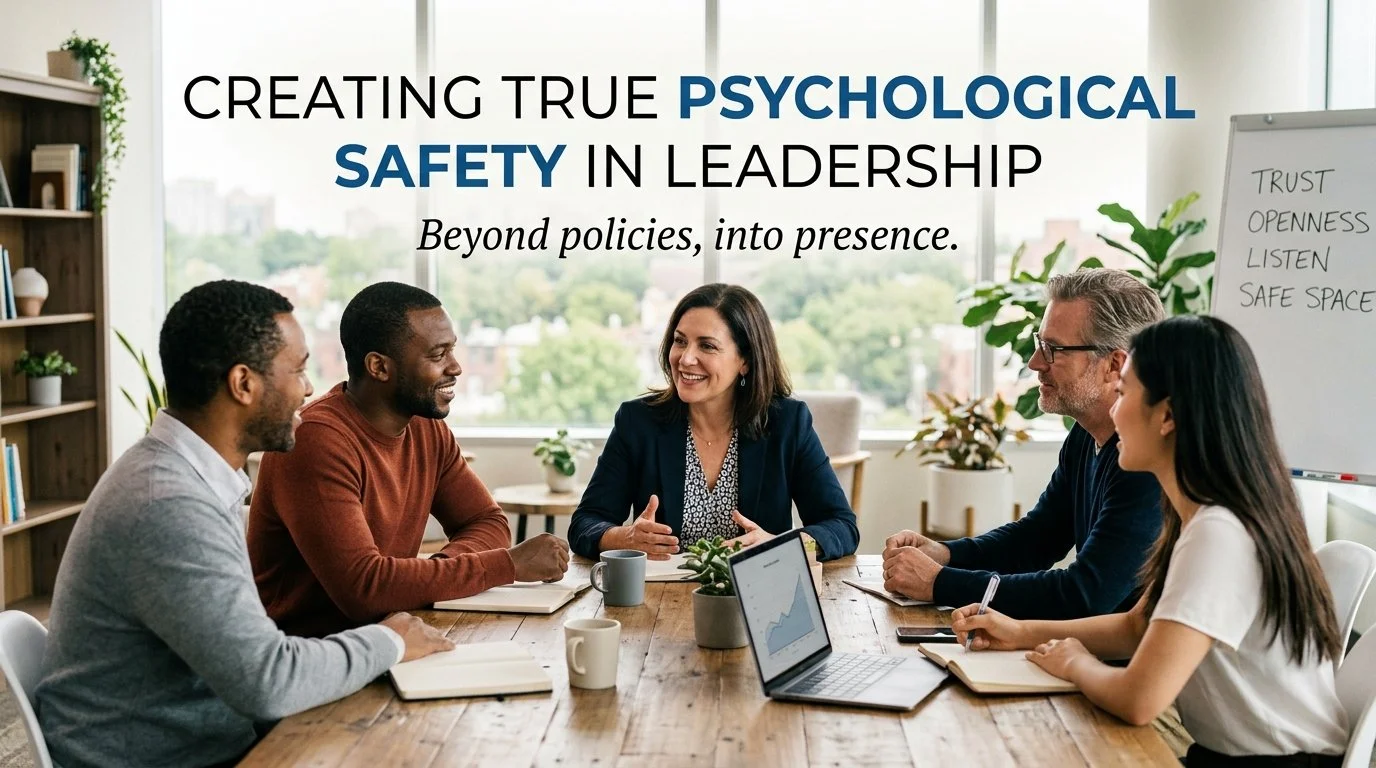
Creating True Psychological Safety in Leadership
Psychological safety has become one of the most talked-about concepts in leadership today. Yet despite its popularity, many organizations still struggle to create it in a way that is real, sustainable, and felt by their people. Why? It is because psychological safety is often treated as a policy or initiative, rather than a relational experience.
True psychological safety is not created through statements or training sessions alone. It is created through the daily posture of leadership—how a leader listens, responds, sets boundaries, and holds space for others.
Beyond policies, into presence
Psychological safety has become one of the most talked-about concepts in leadership today. Yet despite its popularity, many organizations still struggle to create it in a way that is real, sustainable, and felt by their people. Why? It is because psychological safety is often treated as a policy or initiative, rather than a relational experience. However, true psychological safety is not created through statements or training sessions alone. It is created through the daily posture of leadership—how a leader listens, responds, sets boundaries, and holds space for others. At its core, psychological safety is not about comfort. It is about trust. Too often, comfort has taken over the control center of how leaders define their culture.
What Psychological Safety Actually Requires
Leaders who create environments of true psychological safety consistently demonstrate:
Presence before reaction
They listen to understand, not to fix or control.Clarity over ambiguity
Expectations and standards are communicated with respect and consistency.Boundaries without punishment
Accountability is upheld without shame or fear-based control.Respect for emotional reality
People are allowed to express uncertainty, challenge ideas, and be in process.Consistency in conduct
Trust is built through repeated, aligned behavior—not occasional effort.
Psychological safety is not the absence of tension. It is the presence of relational integrity within tension.
Why Most Leadership Approaches Fall Short
Many leaders attempt to create safety by being more agreeable, more accommodating, or less directive. However, safety does not come from being “nice.” It comes from being clear, grounded, and trustworthy. Without structure, safety becomes fragile. Without presence, safety becomes performative. What is needed is a framework that helps leaders understand how their internal state and relational behavior shape culture.
The Role of Relational Leadership
This is where the Relational Leadership Diagnostic becomes essential. The diagnostic introduces leaders to a deeper question: How am I showing up in relationships—and what is that creating in others? Through this lens, leaders begin to see that culture is not built through strategy alone, but through:
Posture
Tone
Consistency
Awareness
Relational intelligence
This is the foundation of trust.
Introducing the Trust Culture Foundations Program
The Trust Culture Foundations Program was designed to help leaders move beyond theory and into applied relational leadership. This program equips leaders with the awareness and tools to:
Recognize how their leadership presence impacts trust
Develop clarity without losing connection
Lead conversations with integrity and emotional intelligence
Create environments where people can contribute fully without fear
It bridges the gap between intention and experience—because culture is not what leaders intend. It is what people consistently experience.
An Invitation to Lead Differently
If you are committed to building a culture where people feel safe to think, contribute, and grow, the work begins with awareness. We invite you to begin with the Relational Leadership Diagnostic and explore how your leadership presence is shaping your environment. From there, the Trust Culture Foundations Program will guide you into a deeper, more sustainable way of leading.
Psychological safety is not something you install. It is something you embody, and when leaders embody trust, culture follows.
Watch the Relational Leadership Diagnostic video here: https://youtu.be/hualmDF8Qv4.
Take the Trust Culture Foundations course for free by joining the AlignSpace Presence Community on Skool. The course is accessible through the Community Classroom.
Link: https://www.skool.com/alignspace-2699/about
Let’s connect!
Click on this link to learn more about Trust Culture Foundations: https://youtu.be/9emjx1p7LOo